

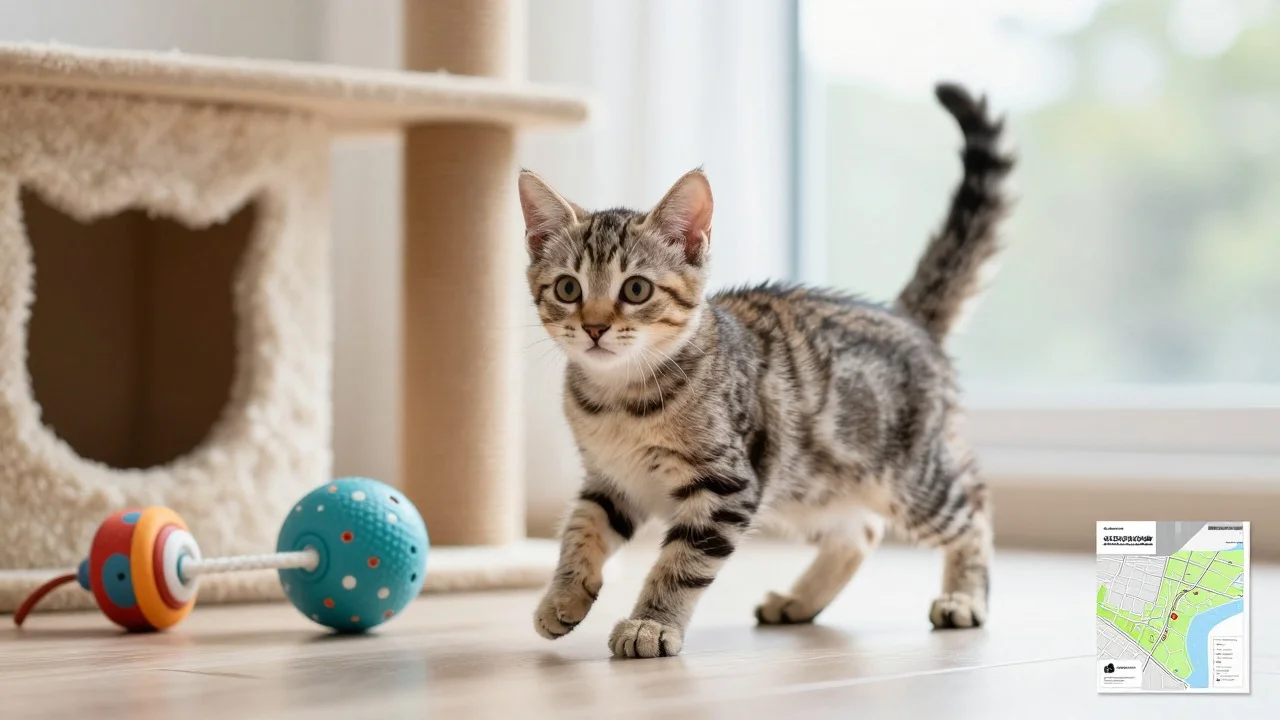
A 4 month old cat is still very much a kitten, but this stage can feel dramatically different from the tiny-kitten weeks. At roughly 16 to 18 weeks, your kitten is becoming faster, more coordinated, more curious, and increasingly confident about exploring every reachable corner of the house. This is also an important month for nutrition, teething, vaccines, behavior training, and planning for spaying or neutering.
Quick answer: A 4 month old cat is an energetic, fast-growing kitten entering a more independent stage. Most need kitten-formulated food about three times a day, ongoing veterinary care, daily interactive play, and a spay or neuter plan before five months. Teething, zoomies, climbing, chewing, and stronger hunting-style play are common.
4 Month Old Kitten at a Glance
| Area | What to Expect at About 4 Months |
|---|---|
| Life stage | Kitten |
| Weight | Often around 4 pounds, but healthy size varies substantially |
| Feeding | Usually about 3 meals daily |
| Food type | Complete and balanced kitten food |
| Teeth | Adult teeth beginning to replace baby teeth |
| Activity | High-energy running, jumping, climbing, stalking, and pouncing |
| Behavior | More confidence, independence, curiosity, and testing boundaries |
| Vaccines | Often nearing the end of the initial kitten vaccine series |
| Spay/neuter | Discuss now; feline guidelines support completion by 5 months for cats not intended for breeding |
| Training | Positive reinforcement, scratching redirection, carrier handling, and gentle socialization |
What Should a 4 Month Old Cat Be Like?
Four months is a transition point between early kittenhood and the increasingly independent juvenile stage. Your kitten should generally be alert, interested in the environment, steadily growing, eating well, grooming, using the litter box, and showing plenty of playful behavior. Individual temperament varies, however, so a quieter kitten is not automatically unhealthy and an extremely active kitten is not automatically hyperactive.
Coordination improves quickly at this age, which is why kittens suddenly seem able to reach places that were impossible only a few weeks earlier. They can sprint, make more accurate jumps, chase toys, climb furniture, and execute surprisingly sophisticated stalking and pouncing sequences. Their growing physical ability means kitten-proofing often needs an upgrade at exactly the same time their confidence is increasing.
How Much Should a 4 Month Old Kitten Weigh?
Around 4 pounds is a commonly used rule-of-thumb estimate for a four-month-old kitten, but it should not be treated as a required target. Research on estimating kitten age from body weight shows that the familiar “one pound per month” rule becomes progressively less reliable as kittens move beyond the earliest weeks. Breed, sex, frame, nutrition, health history, and individual growth pattern all matter. A consistent growth trend and appropriate body condition are more useful than comparing your kitten with one number on a chart.
Weighing your kitten periodically can make changes easier to spot. A kitten that is growing steadily may be perfectly healthy even if it is somewhat smaller or larger than another kitten of the same age. Unexpected weight loss, failure to gain, a pot-bellied appearance, persistent diarrhea, or a very prominent spine and ribs deserve veterinary attention rather than simply increasing food without determining the cause.
Your Kitten’s Personality Is Becoming Easier to See
At four months, kittens often begin showing clearer preferences about people, toys, sleeping places, foods, and how they like to interact. Some become affectionate lap kittens, while others would rather sit beside you and then race away for another round of play. These differences are normal, and forcing attention can make a cautious kitten less comfortable rather than more social.
Confidence can also create behavior that looks mischievous, such as counter exploration, curtain climbing, ankle attacks, stealing objects, and ambushing other pets. Your kitten is not trying to be difficult; these activities use normal feline hunting, climbing, and exploratory behaviors. The goal is to provide acceptable outlets and consistently redirect unwanted behavior before it becomes a well-practiced adult habit.
How Much Should You Feed a 4 Month Old Cat?
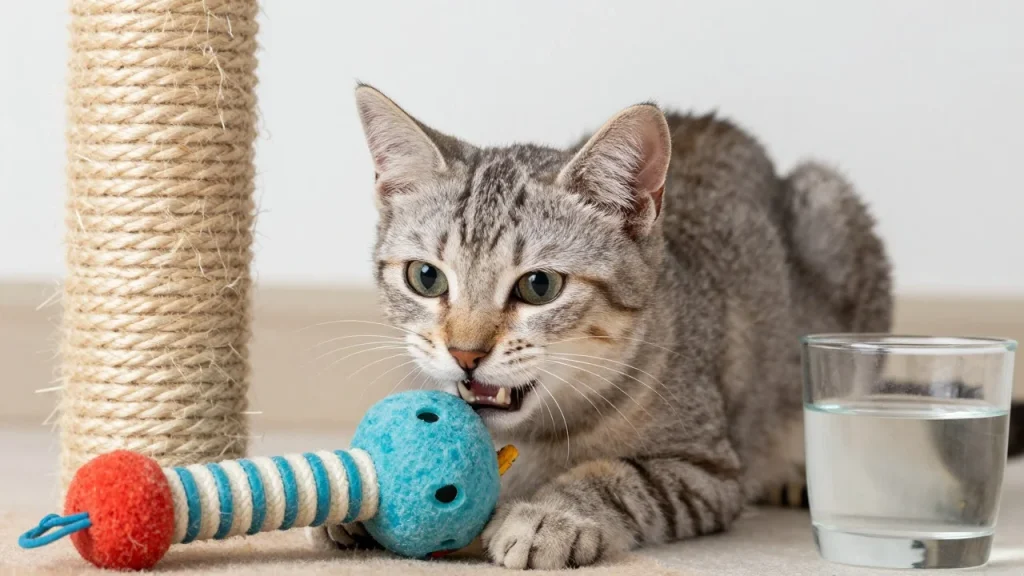
A growing kitten needs substantially more nutrition for its size than an adult cat because food must support both daily activity and rapid physical development. Choose a complete and balanced diet formulated for kitten growth rather than switching to standard adult maintenance food simply because your kitten looks bigger. VCA notes that growing cats have different nutritional requirements from adults and generally recommends kitten food through about 12 months of age.
The exact quantity depends on the calorie density of the particular food, your kitten’s current weight, activity level, body condition, and whether you combine wet and dry food. Start with the feeding instructions for your kitten’s weight and age, then ask your veterinarian to adjust the portion if growth or body condition suggests a change is needed. Measuring portions also makes it much easier to notice an unexplained increase or decrease in appetite.
A Practical Feeding Schedule
Kittens younger than six months generally do well with three meals per day because their nutritional needs are high while their stomachs are still relatively small. Cornell University College of Veterinary Medicine specifically notes that kittens usually do best with three daily meals until six months of age, after which twice-daily feeding is generally suitable through the first year. A morning, afternoon, and evening schedule can therefore work well for many four-month-old kittens.
| Time | Example Routine |
|---|---|
| Morning | Measured kitten meal and fresh water |
| Midday/afternoon | Second measured meal or portion from an automatic feeder |
| Evening | Third measured meal |
| Throughout the day | Fresh water, enrichment, and small training treats as appropriate |
Wet Food, Dry Food, or Both?
Both wet and dry kitten diets can be used when they are nutritionally complete for growth, and many households use a combination. Wet food contributes additional moisture and is often highly palatable, while dry food is convenient for measured meals, food puzzles, and automatic feeders. The most important issue is that the total day’s food supplies appropriate nutrition without routinely exceeding your kitten’s needs.
Fresh water should always be available regardless of how much wet food your kitten eats. Place water where the kitten can easily reach it, and consider more than one bowl if your home has several levels or pets. Wash bowls regularly and pay attention to sudden changes in drinking, because unusually high or low water intake can sometimes accompany illness.
Teething Is in Full Swing at 4 Months
If your kitten has suddenly started chewing more objects or biting during play, teething may be part of the reason. VCA reports that teething commonly begins at roughly three and a half to four months and continues until around six months as the 26 baby teeth are replaced by 30 permanent teeth. You may find a tiny tooth on the floor, although kittens frequently swallow shed baby teeth without any problem.
Provide safe toys that allow chewing without encouraging your kitten to use fingers, electrical cords, furniture edges, or household objects. Avoid extremely hard items that could damage developing teeth, and check toys frequently for pieces that could be swallowed. If your kitten stops eating, appears very painful, has significant oral bleeding, or develops two teeth occupying the same position, arrange a veterinary dental check.
A retained baby tooth can remain beside an erupting permanent tooth and interfere with normal alignment. VCA notes that retained deciduous teeth can trap food, contribute to dental disease, and sometimes require extraction. Smagazinego also has a broader guide to the role of animal clinics in pet dental health if you want to build dental care into your cat’s long-term routine.
Why Is a 4 Month Old Kitten So Hyper?
Four-month-old kittens have a powerful combination of growing muscles, improving coordination, natural hunting instincts, and curiosity about almost everything around them. High-speed zoomies followed by deep sleep, repeated pouncing, chasing, wrestling, climbing, and sudden bursts of play are all common. Regular interactive play gives those instincts an appropriate outlet while strengthening your relationship with the kitten.
Use wand toys, lightweight balls, kicker toys, tunnels, sturdy climbing structures, and food puzzles to create variety. Rotate some toys instead of leaving everything available every day, because novelty can make familiar objects interesting again. Toys involving strings or cords should be put away after supervised play so the kitten cannot chew or swallow them when nobody is watching.
Biting Hands and Feet
Play biting often becomes more noticeable as kittens grow stronger and begin teething. Avoid deliberately wrestling with bare hands, because the kitten can learn that human fingers and ankles are acceptable prey. Instead, calmly stop the interaction and redirect the kitten toward a wand toy, kicker toy, or another object designed for vigorous play.
Punishment, yelling, hitting, spraying water, or frightening a kitten can increase stress without teaching the alternative behavior you actually want. Positive reinforcement works better because you can reward calm handling, appropriate toy play, and use of scratching posts. AAHA’s feline behavior guidance likewise emphasizes positive experiences, gentle handling, rewards, and avoidance of aversive handling or punishment.
Scratching and Climbing
Scratching is a normal feline behavior rather than a problem that can simply be eliminated. Give your kitten both vertical and horizontal scratching surfaces and place them near sleeping areas, favorite rooms, or furniture the kitten already wants to scratch. Rewarding use of appropriate surfaces and making them easy to access are usually more effective than repeatedly moving the kitten away without offering an alternative.
Climbing is equally natural, especially as coordination improves. A stable cat tree, window perch, shelf system, or other secure elevated resting area gives your kitten a legal place to climb and observe the room. Make sure tall furniture cannot tip over when a kitten launches onto it at speed.
Keep Socialization Positive
Although the earliest sensitive socialization period occurs when kittens are younger, positive experiences still matter greatly at four months. Introduce new people, normal household sounds, carriers, grooming, nail handling, and other safe experiences gradually rather than overwhelming the kitten. Pairing these experiences with play, treats, and choice can help create a more confident adult cat.
This is also a useful age to practice touching paws, looking briefly in the ears and mouth, and entering the carrier voluntarily. Keep sessions short and stop before your kitten becomes frustrated or frightened. These small exercises can make future grooming, veterinary exams, medication, and travel considerably easier.
Veterinary Care at 4 Months
Four months is an important veterinary checkpoint because several preventive-care milestones overlap at this age. Your veterinarian may be finishing the kitten vaccine series, checking weight and body condition, discussing parasite control, examining the developing adult teeth, and making plans for spaying or neutering. Establishing consistent preventive care now also gives the clinic a baseline against which future changes can be compared.
If you are still deciding where to establish ongoing care, Smagazinego’s guide to choosing the right animal hospital for long-term pet health explains why continuity and preventive care matter. A veterinarian who knows your kitten’s vaccine history, growth pattern, diet, lifestyle, and previous test results can make more individualized recommendations. Keeping copies of adoption, vaccine, deworming, microchip, and laboratory records makes that process easier.
Vaccines May Still Be Due
Do not assume that a kitten is finished with vaccines merely because several injections have already been given. The AAHA/AAFP feline vaccination schedule recommends repeated core combination vaccination through roughly 16 to 20 weeks because maternally derived antibodies can interfere with earlier doses. Rabies vaccination should follow the licensed vaccine instructions and the applicable state or local requirements, while feline leukemia virus vaccination is considered core for kittens and young cats in current feline life-stage guidance.
Your veterinarian should determine the exact schedule from the kitten’s records, lifestyle, health status, and local disease risks. An indoor kitten still needs a veterinary vaccination plan rather than simply skipping preventive care because outdoor exposure is limited. If records are incomplete or you adopted the kitten from an unknown background, bring whatever documentation you have and let the veterinary team determine the safest catch-up plan.
Talk About Spaying or Neutering Now
Four months is also the time to make a definite spay or neuter plan if your cat is not intended for breeding. The Feline Veterinary Medical Association supports sterilization by five months of age and notes that cats can become reproductively active as early as four to five months, sometimes without obvious warning signs. Waiting for a female kitten to experience a first heat is therefore unnecessary for routine pet cats unless your veterinarian identifies an individual medical reason to use a different schedule.
Your veterinarian can discuss surgical timing based on health, body condition, previous illness, and the clinic’s protocol. Ask about preoperative instructions, pain management, recovery, and how feeding needs may change after surgery. Because energy requirements can decrease after sterilization, continuing to monitor growth and body condition is useful rather than automatically continuing the same portions indefinitely.
Parasite Prevention Still Matters
Kittens can be exposed to intestinal parasites, fleas, ticks, heartworm-carrying mosquitoes, and other parasites depending on their location and lifestyle. Indoor living reduces some exposures but does not eliminate every risk, because mosquitoes, fleas, contaminated soil, and other animals can still bring parasites into the environment. Ask your veterinarian which preventives and testing schedule are appropriate for your region of the United States rather than using products intended for another species or an adult animal.
Never apply a dog flea or tick product to a cat unless a veterinarian has specifically confirmed that the product is labeled and safe for cats. Some canine products contain ingredients that can be dangerous to felines, and kittens have less body mass with which to tolerate dosing errors. Use the kitten’s current weight when selecting any veterinarian-approved preventive. For the full picture, read How many kittens can a cat have.
Kitten-Proof Your Home Again
A home that seemed perfectly safe for an eight-week-old kitten can become much riskier once that kitten can leap onto counters, squeeze behind appliances, climb shelving, and open lightweight doors. Look around from the perspective of an athletic animal that can jump higher than expected and investigate small objects with its mouth. Secure hazards before curiosity finds them.
Pay particular attention to:
Loose thread, yarn, ribbon, dental floss, and hair ties that could be swallowed.
Electrical cords and charging cables that invite chewing.
Open washers, dryers, recliners, cabinets, windows, and balconies.
Human medications and veterinary medications left within reach.
Small objects that could become choking or intestinal foreign-body hazards.
Cleaning products, essential oils, pesticides, and other chemicals.
Toxic houseplants and cut flowers.
Foods that should not be shared with cats.
Lilies deserve special attention in any U.S. household with a kitten. The FDA warns that true lilies and daylilies can cause life-threatening kidney failure in cats, and exposure can occur from petals, leaves, stems, pollen, or even vase water. If you suspect lily exposure, contact a veterinarian or emergency service immediately rather than waiting for symptoms to appear.
Warning Signs That Need a Veterinarian
Kittens can deteriorate more quickly than healthy adult cats because they are smaller and still developing. A sudden change in appetite, energy, breathing, litter-box behavior, balance, or responsiveness deserves attention, particularly when several signs appear together. When you are uncertain, contacting your regular veterinarian for triage is safer than relying on an online symptom list to make a diagnosis.
| Sign | Suggested Response |
|---|---|
| Mild, brief change but kitten otherwise normal | Monitor closely and contact your vet if it persists or returns |
| Repeated vomiting or diarrhea | Same-day veterinary advice, especially with lethargy or poor appetite |
| Sudden refusal to eat with illness signs | Contact a veterinarian promptly |
| Straining repeatedly to urinate or producing little/no urine | Urgent or emergency veterinary evaluation |
| Difficulty breathing | Emergency care |
| Collapse, seizure, severe trauma, or uncontrolled bleeding | Emergency care |
| Suspected toxin or lily exposure | Contact a veterinarian/poison service immediately |
| Rapid weight loss or failure to grow | Veterinary examination |
Urinary straining, difficulty breathing, collapse, major trauma, seizures, uncontrolled bleeding, and known toxin exposure are situations in which waiting can be dangerous. Smagazinego’s guide to urgent care and preventing pet emergencies explains the difference between problems suited to same-day urgent care and those that belong at an emergency hospital. Save your regular clinic and nearest emergency hospital in your phone before you need them.
A Simple Daily Routine for a 4-Month-Old Kitten
A predictable routine helps you meet a young cat’s physical and behavioral needs without turning the day into a complicated schedule. The exact timing can change around work or school, but aim to provide regular meals, fresh water, several opportunities for active play, clean litter, quiet sleep, and positive interaction. Consistency also makes changes in appetite, bathroom habits, or energy easier to notice.
Morning
Offer the first measured kitten meal.
Refresh water and scoop the litter box.
Provide an interactive play session.
Briefly check eyes, nose, coat, movement, and general behavior.
Afternoon
Offer the second meal.
Provide a food puzzle, safe solo toys, or another play opportunity.
Allow uninterrupted sleep after activity.
Evening
Offer the final measured meal.
Schedule active wand-toy or chase play.
Practice a short handling, grooming, carrier, or training session.
Scoop the litter box and put string-type toys away before bedtime.
The routine does not need to be identical every day, and kittens benefit from some novelty in toys and enrichment. What matters is consistently meeting the basic needs for food, water, toileting, play, safety, sleep, and social interaction. Over time, you can adjust the schedule as your kitten approaches six months and eventually moves toward an adult routine.
Frequently Asked Questions
Is a 4-Month-Old Cat Still a Kitten?
Yes, a four-month-old cat is still a kitten and has months of growth and development ahead. Most cats are not considered fully mature at four months, even if they have become dramatically larger and more coordinated than they were at adoption. Continue feeding a kitten diet and following a kitten-specific preventive-care plan unless your veterinarian recommends otherwise.
How Much Should a 4 Month Old Kitten Weigh?
Around four pounds is a useful rough reference for many kittens, but it is not a universal standard. Healthy weight depends on frame, sex, genetics, breed, nutrition, early-life health, and body condition, and the one-pound-per-month estimate becomes less accurate as kittens get older. Your veterinarian can assess whether your kitten is growing appropriately by combining weight history with a physical body-condition assessment.
How Often Should a 4-Month-Old Kitten Eat?
Three meals per day is a practical schedule for many kittens of this age. Cornell advises that kittens generally do best with three daily meals until six months because they require more food per pound of body weight than adult cats. The total daily quantity should still be measured according to the food’s calories, your kitten’s growth, and veterinary guidance.
Can a 4-Month-Old Kitten Eat Adult Cat Food?
Adult maintenance food is generally not the best primary diet for a growing four-month-old kitten because its nutritional needs differ from those of a mature cat. Use a complete diet formulated for growth or an appropriate all-life-stages formula, and continue kitten-focused nutrition through the growth period. VCA generally recommends feeding kitten food until approximately 12 months of age.
Why Does My 4 Month Old Kitten Bite So Much?
Biting can increase at this age because hunting-style play is becoming stronger at the same time teething is beginning. Redirect teeth away from hands and feet toward appropriate toys, and reinforce calm interactions rather than punishing normal kitten behavior. Persistent biting associated with fear, guarding, pain, or major behavioral changes deserves discussion with a veterinarian.
Can a 4 Month Old Cat Get Pregnant?
Pregnancy can become possible surprisingly early because some cats are reproductively active by four to five months of age. This is one reason feline veterinary guidance supports spaying or neutering cats not intended for breeding by five months. Keep an unspayed female securely separated from intact males and discuss surgical timing with your veterinarian now.
Should My 4 Month Old Kitten Be Vaccinated Already?
A four-month-old kitten has normally started its vaccine series, but it may not yet be finished. AAHA/AAFP guidance continues the core kitten combination series through roughly 16 to 20 weeks, with other vaccines and rabies timing determined by risk, product labeling, and applicable law. Ask your veterinarian to review the actual records instead of estimating protection from your kitten’s age alone.
Helping Your Kitten Through the Next Stage
A 4 month old cat is growing quickly enough that feeding, behavior, veterinary care, and home safety can change within only a few weeks. Focus on balanced kitten nutrition, positive play and training, a completed vaccination plan, safe teething outlets, parasite prevention, and timely spaying or neutering while continuing to track growth and behavior. With those foundations in place, the energetic four-month stage becomes an excellent opportunity to build habits that support a healthy, confident adult cat.