

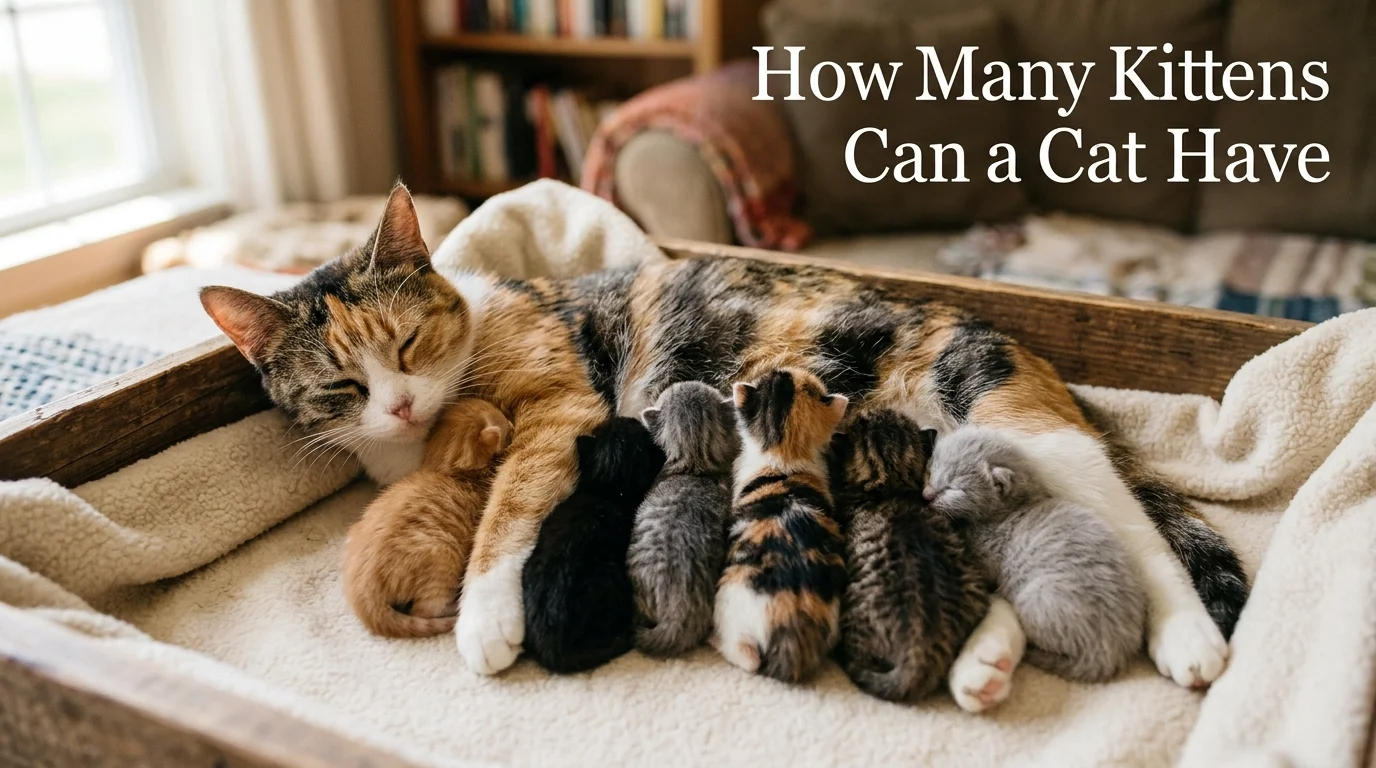
If you are caring for a pregnant cat, one of the first questions you may ask is how many kittens can a cat have in one litter. A typical cat has around four kittens, although many healthy litters contain four to six, and smaller or larger litters are possible. Knowing the likely number can help you prepare for birth, recognize when labor may not be finished, and arrange veterinary care before an emergency develops. You might also like 4 Month Old Cat.
Quick answer: Most cats have roughly four to six kittens in a litter, although the number can range much lower or higher. Large studies have reported averages of about 4.0 to 4.6 kittens, while first litters are often smaller and unusually large litters are relatively rare.
How Many Kittens Can a Cat Have in One Litter?
There is no fixed number of kittens that every cat will deliver. A French study covering 7,075 litters and more than 28,000 kittens found an average of 4.0 kittens per litter, while a UK study of 1,056 pedigree-cat litters found an average of 4.6 kittens. A smaller U.S. research-colony study recorded an average of 3.7 kittens, showing why about four kittens is a useful evidence-based starting point rather than a guaranteed number.
Individual litters can vary considerably around those averages. Some cats have only one kitten, while others may deliver six, eight, or more, and veterinary guidance commonly describes four to six as a practical expectation for owners. Because the largest population studies involve breeding populations rather than a nationwide sample of ordinary U.S. household cats, it is better to treat the figures as useful reference ranges rather than a precise American household average.
| Situation | What owners can generally expect |
|---|---|
| Typical litter | Around 4 kittens |
| Common practical range | Roughly 4–6 kittens |
| First litter | Often smaller than later litters |
| Small litter | 1–3 kittens can occur |
| Large litter | 7 or more is possible but less typical |
| Largest documented litter | 19 kittens |
How Many Kittens Can a Cat Have the First Time?
A cat’s first litter is often smaller than her later litters, although there is no rule guaranteeing a particular number. Research comparing reproductive patterns across pedigree breeds found that first litters were significantly smaller than several subsequent litters, and veterinary-reviewed owner guidance commonly describes one to three kittens as possible in a first pregnancy. A first-time mother can still have more than three, so owners should not use a small expected number to decide that labor must be finished.
This is one reason a prenatal veterinary visit can be more useful than estimating litter size from the cat’s belly. Two pregnant cats of similar size may be carrying very different numbers of kittens, and the mother’s body shape does not provide a reliable count. Knowing the expected number before delivery can make it easier to recognize when another kitten may still be inside.
What Determines How Many Kittens a Cat Has?
Litter size is influenced by several factors rather than one simple cause. Breed, age, reproductive history, health, and genetics can all contribute, and the effect of one factor can differ among individual cats. Researchers have also found meaningful differences among breeds and between first and later pregnancies.
Breed differences can be surprisingly noticeable in research populations. One study of 751 pedigree litters found averages of about 5.0 kittens for Burmese cats, 4.5 for Siamese, 3.9 for Persians, 3.5 for Abyssinians, and 2.8 for Chinchillas. Those figures describe the cats included in that particular study, however, so they should not be treated as a promise about an individual pet.
Age and reproductive history matter as well, but the relationship is more complicated than simply saying older cats always have fewer kittens. Some research populations show increasing litter size after the first pregnancy followed by later decline, while reproductive disease and declining fertility can reduce litter size in mature breeding females. For a pet owner, the important point is that a veterinarian can assess the individual cat rather than trying to predict litter size from age alone.
How Can You Tell How Many Kittens a Pregnant Cat Is Carrying?
A veterinary examination is the safest way to estimate litter size. Ultrasound can help confirm pregnancy earlier in gestation, but counting every fetus accurately can be difficult because kittens can overlap or move during the examination. Later in pregnancy, X-rays become more useful for counting because the developing fetal skeletons become visible.
VCA Animal Hospitals notes that fetal skeletons may be visible on an X-ray at around day 45 of pregnancy, allowing the veterinarian to estimate how many kittens are present. That information is especially valuable when the cat goes into labor because the owner has a better idea of whether delivery is complete. Arrange imaging through a veterinarian rather than trying to determine litter size by pressing or feeling the abdomen at home.
Smagazinego’s coverage of why animal hospitals are important for long-term pet health provides additional context on preventive examinations, diagnostics, and imaging. Establishing veterinary care before kittening also means you already know whom to contact if labor becomes difficult. That preparation can matter more than knowing the exact kitten count.
How Long Is a Cat Pregnant?
Cat pregnancy is much shorter than human pregnancy. VCA gives a typical gestation range of about 60 to 67 days, with 63 to 65 days common, while a large UK study reported an average of 65.1 days. The exact due date can still be difficult to predict because the mating date and actual conception date do not necessarily match.
A pregnant cat may become more interested in finding a private nesting area near the end of pregnancy. Owners should provide a quiet, warm, observable location and keep the expectant mother where her condition can be monitored safely. A veterinarian can also advise on appropriate nutrition, since pregnancy and nursing increase a queen’s nutritional requirements.
How Many Litters Can a Cat Have in a Year?
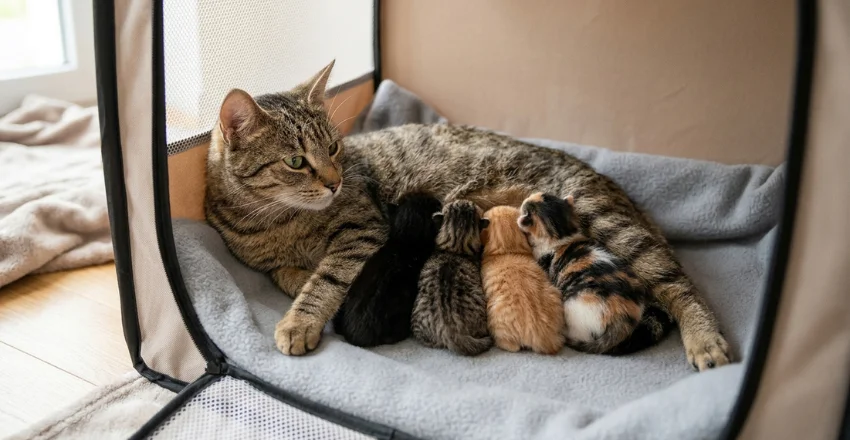
Cats are efficient reproducers, and an unspayed female may produce multiple litters in a year. Reproductive references describe two or even three litters as biologically possible in some circumstances, and females may return to a fertile cycle surprisingly soon after giving birth. That biological ability should not be interpreted as a recommendation to breed a pet repeatedly.
Pregnancy, birth, and lactation all place demands on the mother’s body, while every delivery carries some risk. Responsible breeding therefore requires veterinary oversight, adequate recovery, appropriate nutrition, genetic and health screening, and plans for every kitten produced. For ordinary U.S. companion cats that are not part of a responsible breeding program, major veterinary and animal-welfare organizations recommend spaying rather than allowing repeated pregnancies.
What Is the Largest Litter of Kittens Ever Recorded?
The documented record is far larger than the normal litter. Guinness World Records reports that a Burmese/Siamese cat in Oxfordshire, England, gave birth to 19 kittens on August 7, 1970, although four were stillborn. A 19-kitten litter is an extraordinary outlier and should not be used to estimate what a typical pregnant house cat will produce.
Exceptionally large litters can also create practical challenges because every kitten needs adequate nutrition, warmth, and maternal care. Research has found that kitten birth weight tends to decrease as litter size rises and that stillbirth risk can increase with larger litters. In other words, a bigger litter is not necessarily healthier or more desirable.
Does Litter Size Affect the Mother or Kittens?
Both very large and very small litters can deserve additional attention. The UK study found that larger litters were associated with lower individual kitten birth weights and increased stillbirth risk, while smaller litters were associated with an increased risk of cesarean delivery in that population. Those findings do not mean a complication will occur, but they show why litter size is clinically relevant rather than simply an interesting number.
Birth complications, known medically as dystocia, can occur with any litter size. Causes can include ineffective uterine contractions, an oversized kitten, abnormal fetal positioning, or problems with the mother’s birth canal. Having an established veterinarian and an emergency plan gives the mother and kittens the best chance of getting prompt help if delivery stops progressing normally.
Preparing for Your Cat to Have Kittens
Start preparing before contractions begin, especially if you already know the cat is pregnant. Arrange a veterinary examination, discuss nutrition, provide a quiet nesting space, and ask whether late-pregnancy imaging would be useful for estimating litter size. Also know the location and phone number of a veterinary hospital that can handle an obstetric emergency outside your regular clinic’s hours.
| Before delivery | Why it matters |
|---|---|
| Veterinary pregnancy check | Confirms pregnancy and assesses the mother’s health |
| Late-pregnancy kitten count | Helps determine whether labor may be complete |
| Quiet nesting area | Gives the mother a secure place to deliver |
| Appropriate pregnancy/nursing diet | Supports increased nutritional needs |
| Clean towels and bedding | Helps keep the nesting area dry and comfortable |
| Regular and emergency vet contacts | Reduces delays if complications develop |
Related Smagazinego guidance on pet urgent care and preventing emergencies can help owners understand the difference between a problem that can wait and one that needs faster attention. Pregnancy and labor deserve particular caution because a condition can change quickly when delivery is not progressing. If you’re unsure about an actively laboring cat, calling a veterinarian is safer than relying only on an online timeline.
When Should You Call a Vet During Cat Labor?
Some pauses during kittening can be normal, but prolonged or unproductive labor can signal dystocia. Merck’s veterinary guidance lists strong contractions for more than about 30 minutes without delivering a kitten, or an interval exceeding roughly two hours without contractions between kittens, as warning signs that deserve veterinary attention. Abnormal bleeding, dark green or foul discharge before a kitten is delivered, a trapped kitten, marked weakness, or obvious maternal distress also warrant urgent professional advice.
| Warning sign | Recommended response |
|---|---|
| Strong contractions for 30+ minutes without a kitten | Contact a veterinarian promptly |
| More than about 2 hours between kittens with no contractions | Call for veterinary guidance |
| Kitten visibly stuck | Seek urgent veterinary help |
| Heavy bleeding or abnormal discharge | Seek urgent veterinary help |
| Mother becomes very weak, ill, or distressed | Treat as urgent |
| You know more kittens remain but labor has stopped | Contact your veterinarian |
Do not give oxytocin, calcium, human medication, or other treatments on your own to make labor progress. Merck notes that medications used to stimulate uterine contractions must be chosen only after the cause of difficult labor has been assessed, because an obstruction can make inappropriate treatment dangerous. A veterinarian may use examination and imaging to determine whether medical assistance or a cesarean section is necessary.
Should You Spay a Cat After She Has Kittens?
For U.S. companion cats not intended for responsible breeding, spaying prevents future pregnancies and offers additional health benefits. The AVMA and several feline and shelter-veterinary organizations support spaying or neutering cats by about five months of age. The ASPCA strongly recommends sterilization for companion animals, except when they are part of a responsible breeding program or when surgery is medically contraindicated. There is also no established health benefit to allowing a female cat to have one litter before being spayed.
Discuss the right timing for a mother cat who is currently pregnant or nursing with her veterinarian rather than choosing it from a general online schedule. Her physical condition, the kittens’ age, nursing status, and the clinic’s protocols can all affect timing. U.S. owners who need affordable care can also ask local shelters or veterinarians about low-cost programs, including resources identified by the ASPCA.
Frequently Asked Questions
Can a Cat Have 10 or 12 Kittens?
Yes, a cat can have a litter much larger than average, including 10 or 12 kittens, although such litters are uncommon compared with the roughly four-kitten averages reported in large studies. The documented world record is 19 kittens, demonstrating that the biological upper end can be dramatically higher than the norm. Monitor large litters closely because lower birth weights and other neonatal challenges become more likely as kitten numbers increase.
How Many Kittens Does a First-Time Mom Usually Have?
First-time mothers generally have smaller litters than cats that have already reproduced. Veterinary-reviewed guidance often describes one to three kittens as common for a first pregnancy, but individual cats can have more. The only reliable way to estimate a particular pregnant cat’s litter size is through veterinary assessment and, when appropriate, imaging.
Can a Cat Get Pregnant While She Is Still Nursing?
Yes, some female cats can return to fertile cycling while they are still nursing kittens. Reproductive references report that queens may return to estrus within weeks after weaning and that some resume fertile cycles during lactation itself. Keeping an unspayed nursing mother away from intact males is therefore important if another pregnancy is not intended.
Can an Ultrasound Tell Exactly How Many Kittens a Cat Has?
Ultrasound can confirm pregnancy and assess developing fetuses, but it may not provide a perfectly accurate kitten count. Later-pregnancy X-rays are generally more useful for counting because the kittens’ skeletons become visible, with VCA noting visibility at around day 45. Your veterinarian can recommend the right test based on how far along the pregnancy is and what information you need.
Is One Kitten in a Litter Normal?
A single-kitten litter can occur, so one kitten does not automatically mean something is wrong. However, an owner should not assume delivery is complete simply because contractions stop after one kitten, especially when no prenatal kitten count was performed. Contact your veterinarian if you are uncertain whether more kittens remain or if the mother shows signs of difficult labor.
The Bottom Line
So, how many kittens can a cat have? Around four kittens is a strong evidence-based average, four to six is a useful practical expectation, and both much smaller and much larger litters are possible. If your cat is pregnant, the most useful next step is a veterinary checkup and a delivery plan, not trying to predict the number from her belly alone.
Knowing the expected litter size can help you recognize when birth is complete and when labor may have stalled. Keep your regular veterinarian and an emergency veterinary service available, especially as the due date approaches, and discuss spaying after the kittens are weaned if you don’t plan to breed again. For more pet-care reading, Smagazinego’s Pets section provides additional guides on veterinary care and pet health.