
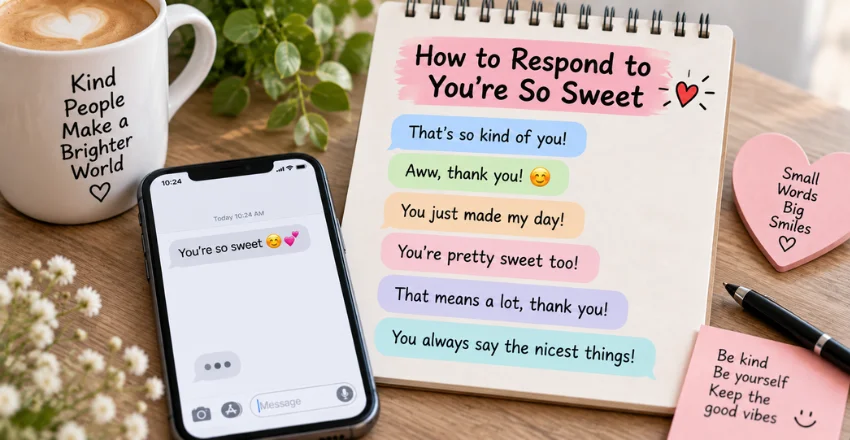
If you’re wondering how to respond to you’re so sweet,” the easiest approach is to accept the compliment and match the other person’s tone. A warm “Thank you, that’s kind of you” works almost anywhere, while friends and crushes leave more room for humor or flirting. Your relationship with the person matters more than finding one perfect line. More from us: You’re Welcome Funny Replies.
Quick answer: When someone says “You’re so sweet,” start with a simple thank-you, then match your relationship’s tone. Keep it warm with a friend, playful with a crush, and professional with a coworker. If you’re unsure, “Thank you, that’s kind of you to say” is a safe response almost anywhere.
| Situation | Good response | Tone |
|---|---|---|
| You’re unsure what they mean. | “Thank you, that’s kind of you.” | Safe and polite |
| A friend says it. | “Aww, you’re sweet too.” | Warm |
| Your crush says it. | “Maybe you bring it out of me.” | Flirty |
| A coworker says it. | “Thank you, I appreciate that.” | Professional |
| You want to be funny. | “I have my moments.” | Playful |
| You don’t want to flirt. | “Thanks, that’s nice of you to say.” | Friendly and neutral |
TL;DR
- A simple thank-you is the safest response.
- Match your reply to your relationship with the person.
- Return the compliment only if you mean it.
- Flirty replies should stay light unless the interest is clearly mutual.
- Keep workplace responses warm but professional.
- Short replies often work best in texts, DMs, and comments.
How to Respond to You’re So Sweet in 5 Simple Steps
You don’t need to come up with a clever answer every time someone compliments you. Most good responses follow the same basic pattern: accept the compliment, read the situation, and choose a natural tone. These five steps can help you answer without sounding awkward or sending a message you didn’t intend.
- Accept the compliment. Start with “thank you.” “I appreciate that,” or another clear acknowledgment.
- Identify the relationship. Think about whether the person is a friend, crush, partner, coworker, or someone you barely know.
- Match the tone. Keep it sincere and keep the conversation playful.
- Choose whether to reciprocate. Compliment them back only when it reflects what you genuinely feel.
- Continue or close the conversation. Add a question or playful comment if you want the chat to continue.
The main mistake is trying too hard to sound original. A natural response usually feels better than a complicated joke you would never normally say. Think about what you want the person to understand after reading your reply, then choose words that support that message.
55 Replies to “You’re So Sweet” for Different Situations
The same compliment can mean different things depending on who says it. A close friend may be showing appreciation, while a crush may be testing the waters with a little flirtation. The following replies give you options without forcing every conversation into the same tone.
Polite and Sincere Replies
A polite reply works when you want to receive the compliment graciously without changing the mood. These answers fit family conversations, new acquaintances, neighbors, classmates, and many everyday situations. They’re also useful when you aren’t sure whether the compliment is romantic.
- “Thank you, that’s kind of you.”
- “I appreciate you saying that.”
- “That means a lot, thank you.”
- “That’s thoughtful of you to say.”
- “Thanks, you made me smile.”
- “I’m glad that came across.”
- “Thank you, I’m happy I could help.”
- “That’s nice of you to notice.”
- “I appreciate the compliment.”
- “Thanks, that made my day brighter.”
Casual Replies for Friends
Friends usually give you more freedom to sound relaxed. You can return the compliment, tease them lightly, or keep your answer short without seeming dismissive. Choose something that sounds like the way you already talk together.
- “Aww, thanks!”
- “You’re sweet for saying that.”
- “Right back at you.”
- “Haha, I’ll take it.”
- “Thanks, I try.”
- “That’s nice to hear.”
- “You’re pretty great yourself.”
- “I’m keeping that compliment.”
- “Now you’re making me smile.”
- “I’ll accept that title.”
Funny Responses
Humor works best when the conversation is already playful. A light joke can keep the exchange moving without turning an ordinary compliment into a serious moment. Avoid sarcasm that could make the other person feel embarrassed for saying something nice.
- “Please put that in writing.”
- “I have my moments.”
- “Don’t tell everyone; I have a reputation.”
- “Must be the coffee.”
- “Sweet, with a little sarcasm.”
- “I’ll add that to my résumé.”
- “Finally, the reviews are in.”
- “Good, my disguise is working.”
- “I was hoping someone would notice.”
- “I’ll try not to let it go to my head.”
Flirty Replies for a Crush or Someone You Like
A flirty response can show interest without making the conversation too intense. The safest choices leave room for the other person to respond rather than forcing the interaction forward. If their compliment already feels playful, you can mirror that energy.
- “Only around people I like.”
- “You make it easy.”
- “Careful, compliments like that might work on me.”
- “Now you’re making me blush.”
- “I could say the same about you.”
- “Maybe you bring it out of me.”
- “Keep talking; I like where this is going.”
- “That sounds extra cute coming from you.”
- “I was saving my sweet side for you.”
- “Keep saying that, and I might like you more.”
Professional Responses for Coworkers
Workplace compliments are usually easier to handle when you keep the reply friendly and measured. You can acknowledge the person without making the exchange unnecessarily personal. If the comment follows something helpful you did, connect your response to the work or team.
- “Thank you, I appreciate that.”
- “That’s kind of you to say.”
- “I’m glad I could help.”
- “Happy to support the team.”
- “Thanks, I appreciate the feedback.”
- “I’m glad that was helpful.”
- “That means a lot; thank you.”
- “I appreciate your kindness.”
Clear communication matters in professional settings because tone can change how a short message is interpreted. Smagazinego’s guide to the 6 Cs of marketing looks at communication from a business perspective if you want to explore that topic further. In a one-to-one workplace exchange, simple language usually gives you the least room for misunderstanding.
Neutral Replies When You Don’t Want to Flirt
You can appreciate a compliment without encouraging romantic attention. A neutral response acknowledges what was said while keeping your intentions clear. If the person continues pushing the conversation in a direction you don’t want, a more direct boundary is reasonable.
- “Thanks, that’s kind of you.”
- “I appreciate the compliment.”
- “Thank you; I’m happy to keep things friendly.”
- “That’s nice of you to say.”
- “Thanks, I’d rather keep this casual.”
- “I appreciate that, but I don’t want to give the wrong idea.”
- “Thank you. I’m more comfortable keeping things professional.”
What Should You Say Based on Who Complimented You?
When a friend says it, you usually don’t need to look for hidden meaning. A casual “You’re sweet too” or “Aww, thanks” keeps the exchange warm without making it bigger than it needs to be. Humor also works well when teasing is already part of your friendship.
When a crush says it, decide whether you want to encourage the connection. A reply such as “Maybe you bring it out of me” communicates interest while giving them room to respond. If you aren’t sure about your feelings, a warm but neutral thank-you prevents you from implying more than you mean.
When a coworker, boss, or professional contact says it, stay closer to gratitude than flirting. “Thank you, I appreciate that” acknowledges the compliment and keeps the conversation moving. That approach is especially useful in written messages, where playful wording can be easier to misread.
How to Reply Over Text, DMs, and Social Media
Text messages give you less information than face-to-face conversations because you can’t hear the person’s voice or see their expression. Keep your first reply short if you aren’t sure what tone they intended, then use their next message as another clue. An emoji can soften the response, but you don’t need one if emojis aren’t part of your usual texting style.
For example, “Aww, thank you 😊” feels warmer than a plain “Thanks,” while “Maybe you bring it out of me 😉” clearly adds flirtation. Smagazinego’s guide to using Genmoji and custom emoji reactions offers more ideas for making digital conversations expressive. Use visual reactions as support for your words rather than relying on an ambiguous emoji to carry the entire message.
Public comments deserve a little more caution because other people can see the exchange. A simple reply such as “Thank you, that’s so kind” often fits Instagram, TikTok, Facebook, or another public platform. If your online profile matters to you, Smagazinego also has a guide to creating and improving profile pictures for social and professional accounts.
Don’t Overthink a Short Compliment
It’s easy to reread a text and wonder whether “sweet” means friendly, romantic, sarcastic, or something else. Look at the conversation around the compliment instead of treating two words as a complete relationship signal. Their usual behavior, your existing relationship, and what they say next give you more information.
If you notice yourself repeatedly checking a chat or social app for clues, give the conversation some space. Smagazinego’s practical guide to stopping doomscrolling may help when online scrolling starts taking more attention than the interaction deserves. A good reply should make communication easier, not turn one compliment into an hour of analysis.
Common Mistakes to Avoid
Receiving a compliment can feel awkward, especially if you weren’t expecting it. Still, dismissing the compliment or immediately questioning the person can make an otherwise pleasant exchange uncomfortable. Accepting the comment first gives you time to decide where you want the conversation to go.
- Don’t argue with the compliment by putting yourself down.
- Don’t force a flirty response when you aren’t interested.
- Don’t return a compliment you don’t mean.
- Don’t use sarcasm with someone who may take it literally.
- Don’t make a workplace exchange more personal than necessary.
- Don’t assume one compliment proves romantic interest.
Choose the Reply That Sounds Like You
The strongest response is usually the one you could imagine saying out loud. Accept the compliment, match the relationship, and don’t feel pressured to be funnier or flirtier than you normally are. A simple answer delivered naturally often creates a better conversation than a clever line that doesn’t fit your personality.
Save a few responses from this list that match your usual style so you don’t have to think from scratch next time. Keep one polite option, one playful option, and one flirty option ready for different situations. Then, when someone sends that sweet compliment, you can answer with confidence and keep the conversation moving.
Frequently Asked Questions
What is the safest answer if I don’t know how to respond to you’re so sweet?
“Thank you, that’s kind of you to say” is a strong neutral choice. It accepts the compliment without sounding cold, overly excited, or romantic. Then you can adjust your tone based on how the rest of the conversation develops.
Is “you’re sweet too” a good response?
Yes, it works well when you sincerely want to return the compliment. It feels natural with friends, family members, partners, and people you already know comfortably. With a new acquaintance or coworker, a simple thank-you may feel more appropriate.
What should I say if my crush calls me sweet?
Try a light response such as “Maybe you bring it out of me” or “Now you’re making me blush.” Both show interest without demanding a particular reaction from the other person. If you want to keep things safer, “That means a lot coming from you” adds warmth, too.
How do I respond without sounding flirty?
Keep the attention on the compliment rather than the person’s attractiveness or your relationship. “Thank you, I appreciate that” and “That’s kind of you to say” are clear choices. A friendly tone can still be warm without signaling romantic interest.
Can I answer with only an emoji?
You can when the relationship is casual, and the meaning is obvious. A smiling face or heart can acknowledge the compliment, but words are clearer when the relationship is new or the situation feels ambiguous. Adding even a short “Thank you” reduces the chance of your reaction being misunderstood.