

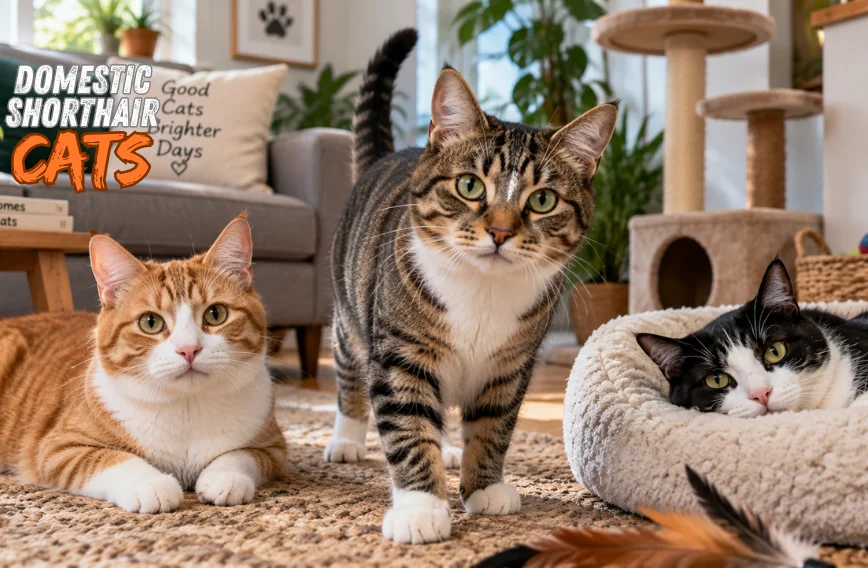
Domestic shorthair cats are short-coated cats with mixed or unknown ancestry rather than a standardized pedigree breed. These cats are common in U.S. homes and animal shelters, yet no single appearance or personality defines them. Their variety is part of what makes understanding the individual cat more useful than relying on a breed stereotype.
If you’re considering adoption, expect a companion whose size, coloring, activity level, and social preferences may differ widely from another short-haired house cat. Most have straightforward grooming needs, but they still need thoughtful nutrition, exercise, preventive veterinary care, and dental attention. Learning the basics can help you judge whether a particular cat fits your household, rather than choosing by appearance alone.
At a Glance
| Domestic Shorthair Cats | Typical Details |
|---|---|
| Classification | Mixed or unknown ancestry; not a standardized pedigree breed |
| Adult weight | Often about 6–16 pounds, with individual variation |
| Adult height | Commonly around 8–12 inches at the shoulder |
| Coat | Short; texture and density vary. |
| Colors and patterns | Nearly every feline color and pattern |
| Lifespan | Commonly around 10–17 years, with some living longer |
| Temperament | Individual; may be affectionate, independent, playful, quiet, or outgoing |
| Grooming | Usually low to moderate |
| Allergy-friendly? | No cat should be assumed to be hypoallergenic. |
| Good for families? | Often, depending on the individual cat and household |
Typical size and lifespan ranges differ somewhat among veterinary and adoption references because this is a broad population rather than a standardized breed. Petfinder lists a 6–16-pound weight range and a lifespan of 10–17 years, while other current guides report similarly broad ranges. That variation is one reason owners should treat published numbers as general reference points rather than strict limits.
Direct answer: The label describes a short-coated house cat with mixed or unknown ancestry, not a standardized pedigree breed. Because ancestry varies, so do size, color, temperament, and activity level. For most owners, good care means balanced nutrition, daily play, routine grooming, dental attention, preventive veterinary care, and a safe indoor environment.
Key Takeaways
- These cats are defined mainly by short coat length and mixed or unknown ancestry, not by a formal breed standard.
- Personality varies considerably, so meeting an adult cat can tell you more than relying on a general temperament description.
- Short fur reduces grooming work, but brushing, nail care, dental care, exercise, and weight management still matter.
- Preventive veterinary care matters throughout life, including vaccines chosen for the cat’s age, lifestyle, and exposure risk.
- A pedigreed American Shorthair differs because it comes from documented breeding lines and is selected to meet a defined breed standard.
What the Term Means
Shelters and veterinary records often use “DSH” as a practical description for a cat with short hair and no documented pedigree. Chewy’s veterinarian-reviewed guide describes the term as a catch-all for short-haired cats with mixed or unknown ancestry. That means two cats carrying the same label may have little in common beyond coat length.
This distinction matters because labels can create false expectations about behavior. One cat may spend every evening on a lap, while another may prefer nearby company without much handling. Age, early socialization, past experiences, health, and the home environment can all influence how an individual behaves.
Domestic Shorthair Cats’ Personality and Family Fit
No single reliable personality profile fits this population. Petfinder notes that individual cats may range from playful and vocal to calm and quiet, while still benefiting from interaction and enrichment. An adult cat’s observed behavior in a foster home or shelter can therefore be more informative than a broad description attached to the coat type.
Families with children or other pets should focus on the individual animal’s history and comfort level. A confident, social cat may adapt well to a busy household, while a cautious cat may prefer predictable routines and quieter spaces. Introduce the cat to children, dogs, and other cats gradually so the newcomer has time to feel secure.
Size, Coat, Colors, and Lifespan
Physical appearance can vary from lean and fine-boned to broad and muscular. Current adoption and veterinary-oriented references commonly place adult weight within a broad range of roughly 6–16 pounds, although healthy weight depends on frame and body condition. Coat colors may include black, white, orange, gray, cream, tabby, tortoiseshell, calico, bicolor, and many other combinations.
Lifespan also varies because genetics are only one part of long-term health. Current sources commonly cite ranges extending from the low teens into the late teens, and some well-cared-for cats live longer. Safe housing, weight control, nutrition, dental health, disease prevention, and timely veterinary treatment can all influence longevity.
Everyday Care: Food, Play, and Grooming
A complete and balanced diet appropriate for the cat’s life stage should form the foundation of feeding. Portion size should reflect body condition, activity, age, and your veterinarian’s advice rather than a generic bowl-filling routine. Cornell notes that obesity is a common nutritional disorder in cats and can worsen problems including diabetes and joint disease.
Daily activity matters even for cats that seem happy to spend much of the day sleeping. Interactive toys, scratching surfaces, climbing areas, food puzzles, and short play sessions give indoor cats outlets for normal hunting and exploration behaviors. Pay attention to what your cat enjoys because activity preferences can differ as much as temperament does.
Short hair usually makes coat care manageable, but “short” does not mean maintenance-free. Cornell recommends regular brushing or combing to remove loose hair and help you notice skin changes or parasites. Nail trimming should also become part of the routine, especially for indoor cats whose claws may not wear down naturally.
Health and Preventive Veterinary Care
Mixed ancestry does not make a cat immune to ordinary feline health problems. Weight gain, dental disease, kidney disorders, urinary problems, parasites, and age-related conditions can still occur, so routine checkups matter even when the cat appears healthy. Smagazinego’s guide to choosing the right animal hospital explains how continuity of care can help veterinarians notice changes across multiple visits.
Vaccination needs should be based on age, prior vaccine history, lifestyle, local requirements, and exposure risk. Cornell identifies vaccination as a core part of feline preventive medicine and advises owners to work with their veterinarian on an appropriate schedule. Rabies rules also vary by jurisdiction in the United States, so owners should check local requirements rather than assume them.
Dental care deserves particular attention because oral disease is common in adult cats. Cornell reports that studies have found dental disease in a substantial proportion of cats older than four, with gingivitis, periodontitis, and tooth resorption among common problems. Smagazinego also has a useful overview of pet dental health and professional care for owners building a long-term routine.
Cats can also develop conditions that require long-term monitoring rather than a single treatment. Changes in appetite, weight, drinking, urination, mobility, or behavior deserve attention, particularly in older animals. For more context, see Smagazinego’s guide to how veterinarians manage acute and chronic pet conditions.
How a Mixed-Ancestry House Cat Differs From an American Shorthair
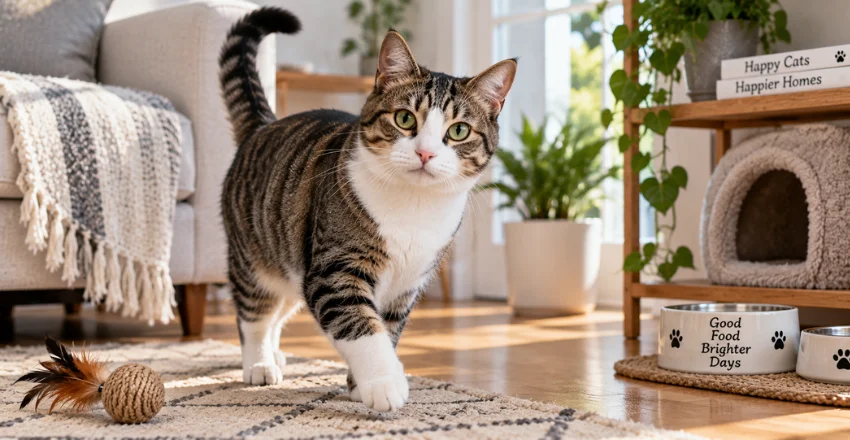
The names sound similar, but the categories are not interchangeable. The American Shorthair is a recognized pedigreed breed with a more predictable physical standard, while a DSH label usually means mixed or undocumented ancestry. A cat that resembles an American Shorthair does not become pedigreed without documented lineage.
| Feature | Mixed-Ancestry Short-Haired Cat | American Shorthair |
|---|---|---|
| Pedigree | Usually unknown or mixed | Documented breeding lines |
| Breed standard | None | Defined breed standard |
| Appearance | Highly variable | More predictable proportions and features |
| Temperament | Highly individual | Somewhat more predictable, though individuals still differ |
| Availability | Common in shelters and rescues | Usually obtained through breed-specific rescue or responsible breeders |
For a family choosing a companion, pedigree status is often less important than health, behavior, age, and household compatibility. Spending time with the individual cat can reveal whether it enjoys handling, seeks social contact, tolerates noise, or prefers a calmer environment. Those observations are especially valuable when adopting an adult whose personality is already easier to assess.
Choosing and Adopting the Right Cat
Start with lifestyle, not coat color. Consider how much time the household is empty, whether children or other pets are present, and how much daily play and interaction you can offer. Ask a shelter or foster caregiver about litter-box habits, handling tolerance, activity level, medical history, and behavior around other animals.
Arrange a veterinary examination soon after adoption, particularly when medical or vaccination history is incomplete. Cornell recommends that new cats receive a veterinary evaluation and appropriate parasite, vaccination, and disease-risk assessment. You can also browse Smagazinego’s Pets section for additional guidance on preventive and emergency animal care.
Prepare for emergencies by saving your regular veterinarian’s details and a nearby emergency facility’s information. Trouble breathing, collapse, major trauma, repeated seizures, severe bleeding, or inability to urinate can require urgent evaluation. Smagazinego explains the basic triage process in its article on how animal hospitals manage emergency situations.
A Good Home Matters More Than a Label
A short-coated mixed-ancestry cat can be affectionate, independent, energetic, reserved, or any combination of those traits. The most useful approach is to evaluate the individual in front of you and build care around that cat’s age, behavior, body condition, and medical needs. That gives you a stronger foundation than relying on a broad label to predict everything.
If you’re preparing to adopt, meet several cats and ask detailed questions about their history and temperament. Once you choose a companion, establish veterinary care early, keep weight and dental health on your radar, and provide safe opportunities for play and rest. Those practical habits give a cat a better chance to stay comfortable and connected to the household for years.
Frequently Asked Questions
Is a domestic shorthair a breed?
No. The term generally describes a short-coated cat with mixed or unknown ancestry rather than a recognized pedigree. Shelters and veterinary clinics commonly use it as a practical classification when no specific breed lineage is documented.
Are these cats hypoallergenic?
Don’t assume a cat is hypoallergenic just because its coat is short. Cat allergens come from proteins associated with saliva, skin, and other biological material, so hair length alone does not remove the allergy risk. People with allergies should spend time around the individual cat before adoption and discuss severe reactions with a healthcare professional.
Do short-haired house cats shed?
Yes, most shed to some degree, though the amount varies by coat density, season, health, and the individual animal. Regular brushing can collect loose hair before it reaches furniture and may reduce how much they swallow during self-grooming. A sudden or excessive change in shedding may warrant a vet check, especially if bald spots or skin irritation appear.
How long can one live?
Many live well into their teens, but no one can guarantee an individual cat’s lifespan. Current guides commonly cite ranges from roughly 10 years into the high teens, with some cats reaching 20 or more. Preventive care, a healthy weight, safe housing, dental care, and early treatment of illness can support a longer, more comfortable life.