

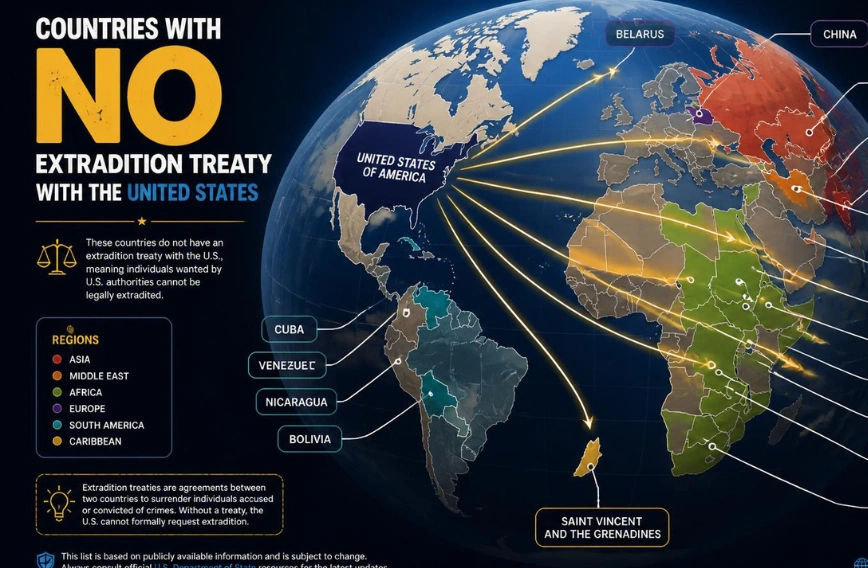
Searching for countries with no extradition treaty with the US often produces lists that make the issue sound much simpler than it is. The United States does not have a bilateral extradition treaty with every country, but the absence of a treaty does not automatically prevent a person from being arrested, deported, expelled, or otherwise returned to U.S. authorities. Extradition rules also change over time, and older treaties can continue to apply through successor-state arrangements. This explainer, part of our law and legal guides, sets out what treaty status decides and what it does not.
Quick answer: Countries without a bilateral U.S. extradition treaty include China, Russia, Iran, Saudi Arabia, the UAE, Qatar, Vietnam, Indonesia, North Korea, Ukraine, and numerous African and Central Asian states. However, no treaty does not mean no surrender, because domestic law, deportation, diplomatic cooperation, or other legal mechanisms may still apply.
| Region | Countries without a bilateral U.S. extradition treaty |
| Europe and Eurasia | Andorra, Armenia, Azerbaijan, Belarus, Georgia, Moldova, Russia, Ukraine, Vatican City/Holy See |
| Middle East and Central Asia | Bahrain, Iran, Kazakhstan, Kuwait, Kyrgyzstan, Lebanon, Oman, Qatar, Saudi Arabia, Syria, Tajikistan, Turkmenistan, United Arab Emirates, Uzbekistan, Yemen |
| East, South, and Southeast Asia | Afghanistan, Bangladesh, Bhutan, Brunei, Cambodia, China, Indonesia, Laos, Maldives, Mongolia, Nepal, North Korea, Taiwan, Timor-Leste, Vietnam |
| Africa | Algeria, Angola, Benin, Botswana, Burkina Faso, Burundi, Cameroon, Cabo Verde, Central African Republic, Chad, Comoros, Côte d’Ivoire, Democratic Republic of the Congo, Djibouti, Equatorial Guinea, Eritrea, Ethiopia, Gabon, Guinea, Guinea-Bissau, Madagascar, Mali, Mauritania, Morocco, Mozambique, Namibia, Niger, Rwanda, São Tomé and Príncipe, Senegal, Somalia, South Sudan, Sudan, Togo, Tunisia, Uganda |
| Oceania | Samoa, Vanuatu |
The table should not be interpreted as a ranking of places where U.S. law cannot reach. A government with no treaty may cooperate closely with U.S. authorities, while another country with a treaty may have constitutional, citizenship, evidentiary, human-rights, or political restrictions affecting a particular request. The Department of Justice specifically warns that extradition law varies substantially from country to country and can involve foreign-policy considerations.
What Does “No Extradition Treaty With the US” Actually Mean?
An extradition treaty creates an agreed legal framework through which one government may ask another to surrender a person wanted for prosecution or punishment. In the United States, international extradition is generally treaty-based, and the Department of Justice extradition guidance explains that the applicable treaty and the requested country’s law shape how a case proceeds. The federal statutory notes accompanying 18 U.S.C. § 3181 contain the principal list of countries with bilateral U.S. extradition agreements.
A country that has no bilateral extradition treaty with the United States therefore has no ordinary treaty obligation to process a U.S. request under a bilateral extradition agreement. That does not create an automatic legal safe haven, because the DOJ notes that some governments may surrender people without a treaty under their own laws, often with an expectation of reciprocity. Other international agreements, immigration rules, deportation procedures, or diplomatic arrangements may also affect an individual case.
Countries With No Extradition Treaty With the US
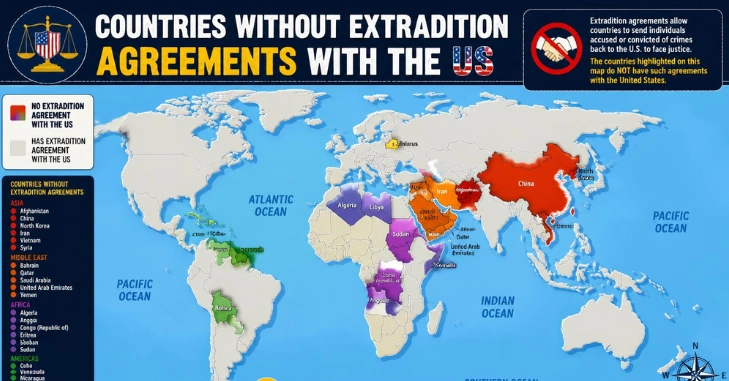
The following is a practical 2026 reference list of countries that are not identified as bilateral extradition partners in the current federal treaty list, while accounting for State Department guidance on older treaties that continue through successor states. Treaty status is legally technical, so this table should be used for general information rather than as a substitute for a current country-specific treaty check. In particular, inherited treaties, multilateral conventions, and new agreements can affect the answer even when a country does not appear as a modern bilateral treaty partner.
Why a No-Treaty Country Is Not Automatically a “Safe Haven”
One of the biggest misconceptions about countries with no extradition treaty with the US is that the lack of a treaty legally prevents any transfer to American authorities. DOJ guidance says some foreign countries permit extradition even without a treaty, generally according to their domestic laws and principles such as reciprocity. The result depends on the foreign government’s legal authority and the facts of the individual case rather than simply on whether a bilateral treaty exists.
International police cooperation adds another layer. An INTERPOL Red Notice can alert authorities around the world that a person is wanted. It can also request that person’s location or a provisional arrest with a view toward extradition or similar lawful action, although a Red Notice is not itself an international arrest warrant. Each country decides what legal effect to give a Red Notice under its own laws, meaning a person can face significant travel and arrest consequences even where the United States lacks a bilateral treaty.
Immigration and passport law may matter as well. DOJ guidance states that the State Department may revoke a U.S. passport when a citizen is subject to an outstanding federal or state warrant, and loss of a valid passport can sometimes affect lawful residence abroad and contribute to deportation. State Department materials likewise describe passport revocation as a tool available in certain fugitive situations.
Some Countries Are Commonly Misclassified Online
Cuba is a useful example of why online “no extradition” lists need careful fact-checking. The federal statutory notes actually list longstanding U.S.-Cuba extradition agreements, even though diplomatic and practical enforcement questions can make real-world cooperation very different from the treaty text. State Department guidance expressly warns that a treaty may be nominally in force while policy or practical circumstances affect whether it can be implemented.
The same caution matters when discussing countries such as Nicaragua and Venezuela because both appear in the federal list of U.S. extradition agreements. Calling a country a “non-extradition country” merely because cooperation has been difficult in particular cases confuses treaty status with actual enforcement. A correct legal article therefore needs to distinguish whether a treaty exists from whether extradition is likely in a specific case.
Successor states create another source of outdated information. State Department guidance explains that the former U.S.-Yugoslavia extradition treaty continued to apply to several successor countries, including Bosnia and Herzegovina, Montenegro, Croatia, Serbia, and North Macedonia, although newer agreements have since replaced older arrangements for some of them. Bosnia’s government, for example, identifies the historic Serbia-U.S. convention as an extradition agreement in force, while the United States entered a new treaty with Serbia in 2019.
Can the US Get Someone Back Without an Extradition Treaty?
Yes, it can happen, although the legal route may differ from formal treaty extradition. A foreign government may have domestic authority to surrender a person without a treaty, or immigration authorities may deport or expel a noncitizen for independent reasons. A person may also later travel into a jurisdiction where arrest and extradition are available.
A recent example illustrates why the treaty question alone does not decide the outcome. In 2025, the Department of Justice announced that Terraform co-founder Do Kwon had been extradited from Montenegro to the United States to face federal charges, demonstrating the importance of international cooperation and the requested country’s own legal procedures. DOJ specifically presented the transfer as an example of how international partnerships can enable U.S. authorities to obtain defendants across borders.
How International Extradition Usually Works
The details vary by treaty and country, but extradition normally involves both judicial and executive action. The DOJ Office of International Affairs coordinates U.S. international extradition matters, while diplomatic communications also involve the Department of State. A foreign court or other competent authority then applies the relevant treaty and domestic law before the requested government decides whether surrender is legally authorized.
A simplified process may involve:
- U.S. authorities obtain the necessary criminal charge, judgment, or arrest warrant.
- Federal authorities determine whether extradition is legally available.
- The formal request is prepared and transmitted through the appropriate government channels.
- Authorities in the requested country may arrest the person under treaty and local-law procedures.
- A court or other authority considers whether the legal requirements for extradition are satisfied.
- The requested country’s executive authorities make any final surrender decision required by its law.
This process is different from simply asking foreign police to send someone to the United States. Extradition proceedings may examine identity, treaty coverage, the charged offense, supporting evidence, dual criminality, citizenship restrictions, and other conditions imposed by the treaty or foreign law. The DOJ emphasizes that these requirements can differ greatly between countries.
What Factors Can Affect an Extradition Request?
Treaty status is only the beginning of an extradition analysis. The person’s citizenship, the nature of the alleged offense, the location of the conduct, available evidence, applicable limitations periods, and the laws of the requested state can all matter. Some countries also restrict or prohibit extradition of their own nationals.
| Factor | Why it matters |
| Treaty status | Determines whether the usual bilateral treaty process is available |
| Dual criminality | Many modern treaties require the conduct to be criminal in both countries. |
| Citizenship | Some countries restrict extradition of their nationals. |
| Type of offense | Treaty provisions may exclude or specially regulate certain offenses. |
| Evidence | The requesting government must satisfy treaty and local evidentiary requirements. |
| Human rights protections | Foreign law may restrict surrender where legally recognized protections apply. |
| Local immigration law | Deportation or removal can operate separately from extradition |
| International cooperation | INTERPOL and diplomatic channels can remain relevant even without a bilateral treaty. |
Those distinctions are why the phrase “non-extradition country” can be misleading. Treaty coverage does not guarantee surrender, while the absence of a treaty does not guarantee protection from surrender. A reliable answer requires examining the law of both countries and the circumstances surrounding the particular request.
What Should Someone Facing a Real Extradition Issue Do?
A person who is actually subject to an arrest warrant, criminal charges, or an international extradition request needs advice from a lawyer experienced in criminal and international matters. Internet country lists cannot establish whether a treaty applies, whether an INTERPOL notice exists, whether deportation is possible, or what defenses may be available under the foreign country’s law. Legal advice should therefore be based on the actual charging documents, citizenship, location, and applicable international agreements.
Choosing counsel carefully matters because extradition is a specialized area involving more than ordinary domestic criminal procedure. Our guide to questions to consider when choosing an attorney covers experience, communication, fees, and case strategy, and those same prompts work well when interviewing a lawyer about an international matter.
The Bottom Line
The list of countries with no extradition treaty with the US is useful for understanding the reach and limits of formal American extradition agreements, but treaty status is only one piece of the legal picture. No treaty does not mean no arrest, no deportation, no international police cooperation, or no eventual return to the United States. Anyone affected by an actual warrant or extradition proceeding should obtain country-specific legal advice instead of relying on an online list as a prediction of what authorities will do.
Frequently Asked Questions
Which countries have no extradition treaty with the United States?
Major examples include China, Russia, Iran, Saudi Arabia, the United Arab Emirates, Qatar, Vietnam, Indonesia, Ukraine, and North Korea. Numerous countries in Africa, Central Asia, and Southeast Asia also lack bilateral U.S. extradition treaties. The exact answer should always be checked against current federal and State Department treaty records because treaty relationships can change.
Does no extradition treaty mean the US cannot get someone back?
No. Some countries can surrender individuals under domestic law even without a bilateral treaty, while deportation, immigration removal, or other lawful transfers may provide separate routes. International police cooperation can also locate a wanted person and create arrest consequences under the law of another country.
Can INTERPOL arrest someone in a country with no US extradition treaty?
INTERPOL itself does not arrest people, and a Red Notice is not an international arrest warrant. A Red Notice informs member countries that a person is wanted and requests location and, where domestic law permits, provisional arrest in anticipation of extradition or another lawful process. Whether an arrest occurs depends on the law and practice of the country where the person is located.
Does the United States have an extradition treaty with Russia?
The United States does not have a bilateral extradition treaty with Russia. That absence removes the ordinary bilateral treaty framework but does not necessarily eliminate every possible form of international law-enforcement cooperation or later arrest in another jurisdiction. Any actual case would depend on citizenship, location, charges, travel, and the laws of the countries involved.
Does the US have an extradition treaty with China?
The United States does not have a bilateral extradition treaty with mainland China. Hong Kong historically had a separate surrender agreement with the United States, illustrating why legal arrangements involving China cannot be reduced to a single regional label. Current governmental policy and the status of any particular agreement should therefore be verified before drawing conclusions in an individual case.
Does the United States have an extradition treaty with the UAE?
The United Arab Emirates is not listed among the bilateral U.S. extradition partners in the current federal statutory list. Even so, the absence of a treaty should not be interpreted as a guarantee that a wanted person cannot be detained, removed, or transferred through another lawful mechanism. The outcome of any request would depend on UAE law, diplomatic cooperation, immigration status, and the facts of the case.