

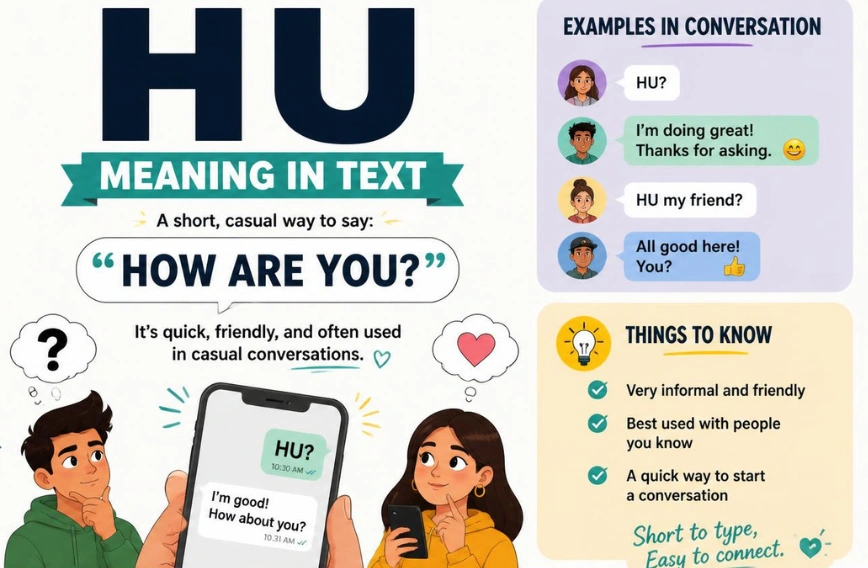
If you’re searching for HU meaning in text, the safest answer is that those two letters can represent several informal expressions. Common readings include “hit up,” “hook up,” “who,” “huh,” and sometimes “hold up.” The right interpretation depends more on the surrounding message than on the abbreviation alone.
Quick answer: HU in a text does not have one fixed meaning. It can mean “hit up” or “hook up,” while lowercase “hu” may stand in for “who” or “huh.” Some texters also use it for “hold up.” The surrounding sentence, tone, and relationship usually tell you which reading fits. Our related guide, What Do FS Mean in Text, goes further into this.
HU Meaning in Text: Quick Answer
Current slang pages don’t agree on one universal expansion, which is an important clue by itself. Some identify “hit up” as the main meaning, while others favor “hook up,” “who,” or “hold up.”
| What you see | Likely meaning | What the sender may mean |
|---|---|---|
| “hu is this?” | Who | Asking for someone’s identity |
| “hu?” | Who or huh? | Asking who, or showing confusion |
| “I’ll HU later” | Hit up | Contact or message later |
| “wanna HU?” | Hook up | Meet up, sometimes romantically or sexually |
| “HU, wait” | Hold up | Pause or wait a moment |
Treat the table as a decoder, not a dictionary rule. Internet shorthand develops informally, so two people may use the same abbreviation differently. Reading the full sentence is usually more useful than memorizing one definition.
TL;DR
- Context matters more than capitalization alone.
- “Hit up” usually involves contacting or reaching someone.
- “Hook up” can mean meeting and may have romantic or sexual meaning.
- Lowercase “hu” can be a quick spelling of “who” or a reaction similar to “huh?”
- If the message could be interpreted two ways, asking what the sender means is the safest response.
Does HU Mean “Hit Up” or “Hook Up”?
Both interpretations appear in current online usage, but they do different jobs in a sentence. Collins includes “hit up” as slang that can mean making contact with someone, while everyday American usage also applies the phrase to approaching someone for something.
That reading fits messages about calling, messaging, tickets, plans, or getting in touch later. A sentence such as “I’ll message later” has no romantic implication by itself, so a contact-related reading makes more sense there. The surrounding verb, object, and topic provide stronger evidence than the abbreviation alone.
“Hook up” needs a separate interpretation because the phrase has several established meanings. Cambridge Dictionary includes meeting someone and beginning a romantic or sexual relationship among its informal meanings.
That makes dating context especially important. If two people have been discussing attraction, dating, or meeting privately, the romantic reading becomes more plausible. You still shouldn’t assume sexual intent without enough context because “hook up” can also refer more broadly to meeting or connecting.
How to Tell the HU Meaning in Text From Context

Start by looking at the words immediately before and after the shorthand. If it appears where the word “who” would normally belong, the sender may simply be shortening that word. If it follows a discussion about contacting someone, “hit up” becomes more likely.
Next, consider theconversation’ss subject and your relationship with the sender. A classmate discussing notes, a friend making weekend plans, and a dating-app match may use the same two letters with different intentions. The topic often provides a clearer clue than uppercase versus lowercase spelling.
Capitalization can still offer a small hint, but it isn’t a dependable rule. People capitalize text accidentally, type in all lowercase, or rely on autocorrect settings that vary by device. Treat the sentence pattern as stronger evidence and capitalization as a secondary clue.
A useful test is to replace the abbreviation with each possible meaning and reread the sentence. The version that sounds natural and fits the conversation is usually your best interpretation. If two versions still make sense, clarification is better than guessing.
What It Can Mean on Snapchat, Instagram, and Regular Texts
Snapchat and other quick-message platforms encourage short replies so that a two-letter response may save typing. A reply after a confusing Snap could function like “huh?” while a message about another person could mean “who?” Platform alone cannot establish the sender’s intention.
On Instagram and similar social platforms, the surrounding DM or comment thread matters in the same way. Someone interested in visual communication can also explore Smagazinego’s guide to using Genmoji in messages and social apps, since emojis and reactions often add context that plain abbreviations lack. Those extra signals can make a short message easier to interpret.
Profiles can provide context too, especially when you’re talking with someone you don’t know well. Smagazinego’s profile-picture and online identity guide covers another part of how people present themselves across social platforms. Still, you should interpret a message from the conversation itself rather than making assumptions based on a profile.
Regular SMS and iMessage conversations can be easier because you often already know the sender. Shared habits, earlier messages, and your usual way of speaking can quickly narrow the possibilities. A shorthand expression that looks confusing to an outsider may be completely clear between close friends.
Real Text Examples and What They Probably Mean
The fastest way to understand ambiguous slang is to compare the expression with the sentence around it. These examples show how small changes can shift the likely interpretation. None should be treated as a universal rule.
| Example message | Most likely reading | Why |
|---|---|---|
| “hu told you?” | Who | The sentence asks about a person |
| “Someone from work called.” “hu?” | Who or huh? | The reply asks for clarification |
| “I’ll HU after class” | Hit up | The sentence points to contact later |
| “Do you wanna HU tonight?” | Hook up | The wording can suggest meeting, especially in dating context |
Notice that the same letters can act almost like different words. Sentence structure removes much of the uncertainty before you even consider the platform. That is why context-first decoding works better than a single fixed definition.
Is This Slang Flirty?
The shorthand is not automatically flirtatious. A contact-related use can be completely friendly, practical, or neutral, especially when people are discussing school, work, gaming, tickets, or plans. The conversation needs additional romantic signals before you should read more into it.
A dating conversation can change that interpretation. A private invitation to meet, especially after romantic conversation, may point toward “hook up” rather than simple contact. If the distinction matters to you, ask what the person has in mind before agreeing to anything.
How Should You Reply When the Meaning Is Unclear?
The easiest response is a short request for clarification. You can ask “What do you mean?” or repeat the part of the message you’re unsure about. That gives the sender a chance to explain without turning a simple abbreviation into an awkward misunderstanding.
If the context is romantic, clarity matters even more. You can ask whether they mean talking, hanging out, dating, or something more intimate. Clear wording helps both people understand the invitation and decide what they are comfortable with.
You don’t need to copy the same slang in your reply either. Writing complete words can make the conversation clearer while keeping your tone casual. This approach works especially well when you’re texting someone whose slang habits you don’t know yet.
Should You Use It at Work or in Formal Messages?
Avoid ambiguous shorthand in professional communication when a clearer expression is available. “Message me later,” “please contact me,” “wait a moment,” or “who is responsible?” take only a little more space and leave less room for confusion. Clear wording matters more than saving a few keystrokes in emails, client chats, and workplace messages.
The same principle applies when communicating with teachers, customers, new coworkers, or people outside your usual social group. Informal slang works best when both people already understand the shared meaning. For more digital and technology explainers, you can browse Smagazinego’s Tech section.
The Simple Rule to Remember
Two letters rarely provide enough information to decode an entire conversation. Look at the surrounding sentence first, then consider the topic, relationship, and platform. That method handles ambiguous shorthand more reliably than assigning one permanent definition.
If you keep encountering unfamiliar abbreviations online, treat context as your first dictionary. Social media changes quickly, and informal expressions often develop several meanings at once. Read the message as a whole, ask when necessary, and you won’t have to guess what the sender intended.
Frequently Asked Questions
What does HU meaning in text usually refer to?
TNosingle meaning tits every message. Depending on context, it may represent “hit up,” “hook up,” “who,” “huh,” or “hold up.” Read the entire sentence and conversation before choosing one interpretation.
Can lowercase “hu” mean “who”?
Yes, current texting guides document lowercase “hu” as an informal spelling of “who,” especially inside questions. A message asking about a person is the strongest clue that this reading fits.
Can it mean “huh?”
It can function like “huh?” when someone sends it as a short reaction to something confusing or surprising. That use is more likely when the abbreviation appears by itself after another message. If the conversation is asking about a specific person, “who?” may fit better.
Does its meaning change when a guy or girl sends it?
The sender’s gender does not determine the meaning. Conversation topic, relationship, timing, and sentence structure give you much better clues. A friend and a dating match can use identical shorthand with entirely different intentions.
What is the safest reply if I don’t understand it?
Ask the sender to clarify what they mean. A simple question prevents you from assuming they want contact, a meetup, or something romantic. It also lets the conversation continue naturally without pretending you understood unfamiliar slang.