
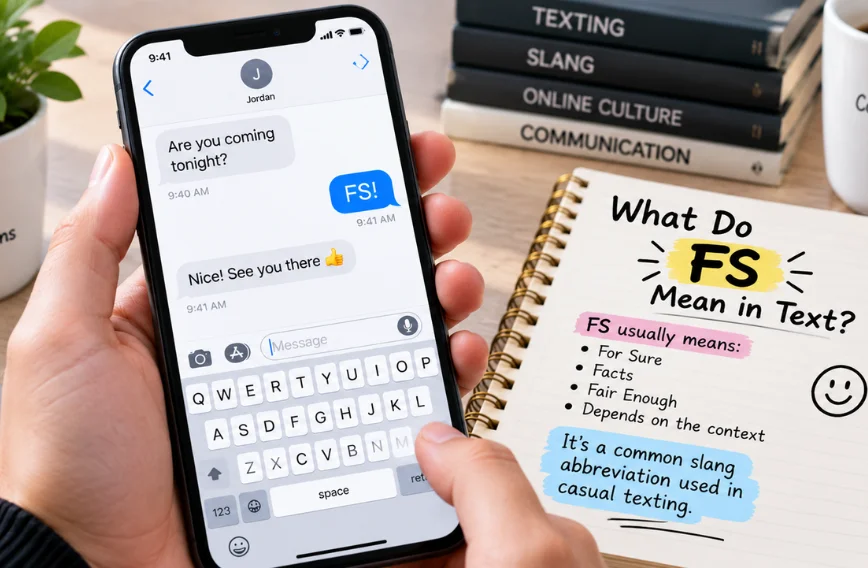
If you’re asking what do FS mean in text, the answer is usually “for sure.” People use this short form to agree, confirm plans, or show certainty in casual messages. The surrounding conversation tells you whether another meaning fits better. Elsewhere on the site: HU Meaning in Text.
| What Do FS Mean in Text | Meaning |
|---|---|
| Most common texting meaning | For sure |
| Typical tone | Casual, confident, friendly |
| Common places | Text messages, DMs, comments, group chats |
| Other possible meanings | For sale: full send, file system, financial statements, free safety |
| Best context clue | Read the words before and after the abbreviation. |
| Formal use | Usually better avoided |
Quick answer: FS usually means “for sure” in a text, DM, or social media conversation. It works like “definitely,” “absolutely,” or a confident “yes.” In marketplace listings, technical discussions, business conversations, or American football, the same letters can mean something different.
Key Takeaways
- In an ordinary conversation, read the abbreviation as “for sure” first.
- It can show agreement, confirmation, confidence, or enthusiasm.
- Marketplace posts may use it to mean “for sale.”
- Punctuation and capitalization can change the tone without changing the basic meaning.
- The sender’s gender usually doesn’t change the definition.
- Use the surrounding topic to identify less common meanings.
What Do FS Mean in Text?
In everyday texting, the abbreviation normally stands for “for sure.” It’s a compact way to say you agree with someone or feel certain about something. Abbreviation references also classify it as texting and internet slang for “for sure.” The phrase can replace words such as “definitely,” “absolutely,” and “certainly.”
It can also act as a complete yes when someone asks about plans. The result is a short reply that fits naturally into informal digital conversations.
Common Texting Examples
- “Are you coming to the game?” → “fs”
- “That restaurant was good.” → “FS.”
- “Can you send the photos later?” → “Yeah, fs.”
Each example carries a slightly different purpose, but the central idea stays the same. The first confirms a plan, the second shows agreement, and the third promises an action. Reading the complete exchange is usually enough to understand the sender.
Other Meanings You Might See
The abbreviation isn’t limited to casual chatting. Its meaning can change when you move from a personal conversation to shopping, technology, finance, or sports. That’s why context matters more than memorizing one definition.
| Meaning | Where you may see it | Example context |
|---|---|---|
| For sure | Texts, DMs, comments | Agreeing or confirming |
| For sale | Marketplace and classified listings | An item is available to buy. |
| Full send | Gaming, sports, casual slang | Committing fully to an action |
| File system | Computing and IT | Storage or file-management discussions |
| Financial statements | Accounting and business | Reports about company finances |
| Free safety | American football | A defensive position |
“For sale” is one of the easiest alternatives to recognize in the U.S. A post that names an item, price, condition, or pickup location is probably talking about a sale rather than an agreement. A listing such as “desk, $40, pickup only” gives you enough context to make that distinction.
The same logic works in technical and professional conversations. A developer discussing storage is probably referring to a file system, while an accountant may be discussing financial statements. In an NFL or college-football conversation, the letters can refer to the free safety position.
What It Means on iMessage, Snapchat, TikTok, and Instagram
The basic slang meaning usually stays consistent across popular messaging and social platforms. In an iMessage conversation or Snapchat chat, it commonly signals agreement or confirmation. TikTok and Instagram users rely on the same shorthand in comments, captions, and DMs.
The app itself matters less than the conversation around the abbreviation. A TikTok comment agreeing with an opinion will probably mean “for sure,” while a social marketplace post can point toward “for sale” instead. If you enjoy personalizing digital conversations, Smagazinego’s guide to using Genmoji on an iPhone covers another part of modern messaging culture.
Does Capitalization or Punctuation Change the Tone?
Capitalization can make a short message feel stronger, although it doesn’t automatically create a new definition. Lowercase text often looks relaxed, while uppercase letters can appear more confident or energetic. Punctuation and emojis add another layer of tone.
| Version | Likely impression |
|---|---|
| fs | Relaxed and casual |
| FS | Clear and confident |
| FS! | Enthusiastic or excited |
| fs. | More restrained or dry |
These differences aren’t fixed grammar rules. People have individual texting habits, and a period may mean nothing more than personal preference. Look at the sender’s usual style before assuming a short reply is annoyed or sarcastic.
Online presentation can shape how messages are perceived in other ways too. Profile photos, emojis, usernames, and message style all contribute to a person’s digital identity. Smagazinego’s profile picture creator guide offers related tips for managing that visual side of social media.
How to Tell the Right Meaning in About 10 Seconds
You usually don’t need a slang dictionary every time two unfamiliar letters appear. Start by looking at what the other person is responding to, then identify the conversation topic. Most ambiguous uses become clear once you apply a few simple checks.
- Read the previous message. A yes-or-no question usually points toward “for sure.”
- Check for products and prices. Shopping language makes “for sale” more likely.
- Look at the topic. Technology, accounting, or football can produce specialized meanings.
- Notice the position. A short reply by itself often expresses agreement or confirmation.
- Check the tone. Emojis, punctuation, and nearby words can reveal whether the sender sounds excited, serious, or casual.
Don’t interpret the abbreviation in isolation when the conversation provides more context. If one meaning sounds strange when substituted into the sentence, try the next likely option. That simple replacement test handles most everyday cases.
How Should You Reply?
Your response depends on what the other person is doing with the slang. If they’re confirming plans, you can continue the conversation without acknowledging the abbreviation itself. If they’re agreeing with an opinion, a short reaction or follow-up comment usually feels natural.
| Message you receive | Natural reply |
|---|---|
| “Yeah, I’m coming.” | “Perfect, see you there.” |
| “That movie was great.” | “I liked the ending too.” |
| “I can send it tonight.” | “Thanks, I appreciate it.” |
| Marketplace context | Ask about price, condition, or availability. |
You don’t have to copy someone’s slang to sound friendly. A normal “sounds good,” “definitely,” “thanks,” or “see you then” works perfectly well. Match the relationship and situation rather than forcing an abbreviation you wouldn’t normally use.
Is This Slang Appropriate at Work or School?
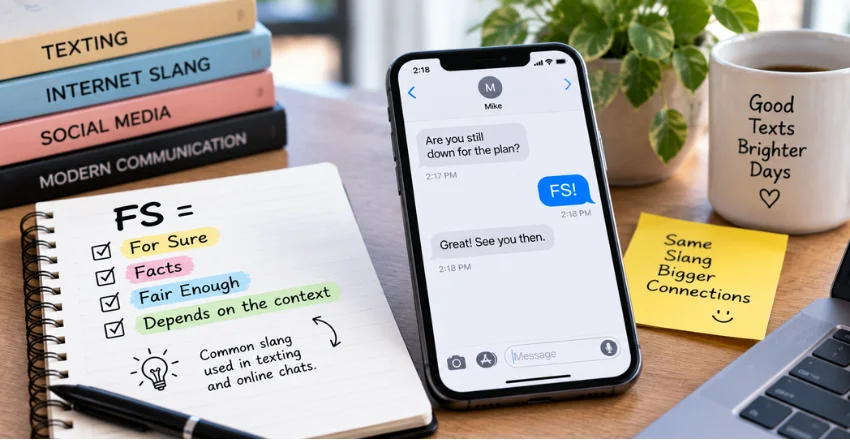
Keep short internet slang to informal conversations unless you know the setting welcomes it. A quick message between close coworkers may be fine, but an email to a manager, client, professor, or school administrator calls for clearer language. Writing “certainly,” “yes,” or “I can confirm” removes unnecessary ambiguity.
The same rule applies whenever your message may be saved, forwarded, or read without the original conversation. Clear wording becomes more useful when context is limited. Casual shorthand works best when both people already understand the tone and topic.
Digital communication habits can also affect how much time you spend checking chats and social feeds. If constant notifications keep pulling you back into your phone, Smagazinego’s guide on how to manage doomscrolling offers practical ways to regain control of screen time. Better communication isn’t only about understanding slang; it also includes deciding when to put the screen down.
Similar Texting Slang You May See
Modern messages contain plenty of abbreviations that perform similar jobs. Some confirm a point, while others show honesty, surprise, or agreement. Learning a few common ones can make group chats and social comments easier to follow.
- FR: for real
- NGL: not gonna lie
- TBH: to be honest
- IKR: I know, right?
- IDK: I don’t know
- LMK: let me know
These terms aren’t interchangeable even when they appear in similar conversations. “FR” often stresses sincerity, while “TBH” introduces an honest opinion and “LMK” asks someone to provide information later. Reading the full sentence remains the safest way to interpret any shorthand.
The Simple Rule to Remember
In a normal American text conversation, start with “for sure” and change your interpretation only when the context points elsewhere. Products and prices suggest “for sale,” while technology, finance, and football may use specialized definitions. That one context check can prevent most misunderstandings.
Want to understand more about technology, social media habits, and everyday digital tools? Browse Smagazinego’s latest tech guides for practical explanations and tutorials. Keep the context in mind, and unfamiliar online shorthand becomes much easier to read.
Frequently Asked Questions
What Do FS Mean in Text?
It most commonly means “for sure” in casual texts and online conversations. The expression can communicate agreement, certainty, confirmation, or an enthusiastic yes. If the message is part of a normal conversation between friends, this is usually the meaning to try first.
Can the Abbreviation Mean “For Sale”?
Yes, especially in marketplace listings, classified posts, and buy-and-sell groups. A product name, dollar amount, condition description, or pickup information makes the shopping much more likely. The rest of the listing normally removes any uncertainty.
Is It Rude to Use?
The abbreviation isn’t inherently rude when it means “for sure.” A short reply can feel dry in some conversations, but that depends on punctuation, relationship, and the sender’s normal texting style. Don’t assume negative intent from two letters alone.
Does It Mean Something Different From a Guy or a Girl?
The basic meaning doesn’t change because of the sender’s gender. A guy, girl, friend, partner, or family member can all use the same shorthand to express agreement or certainty. Any romantic or emotional meaning comes from the surrounding conversation, not the abbreviation itself.
What Should I Do If I Still Can’t Tell What It Means?
Read the previous few messages and identify the topic first. If several meanings still seem possible, asking “What do you mean by that?” is clearer than guessing. Slang is supposed to speed up communication, so it’s fine to ask when it does the opposite.