

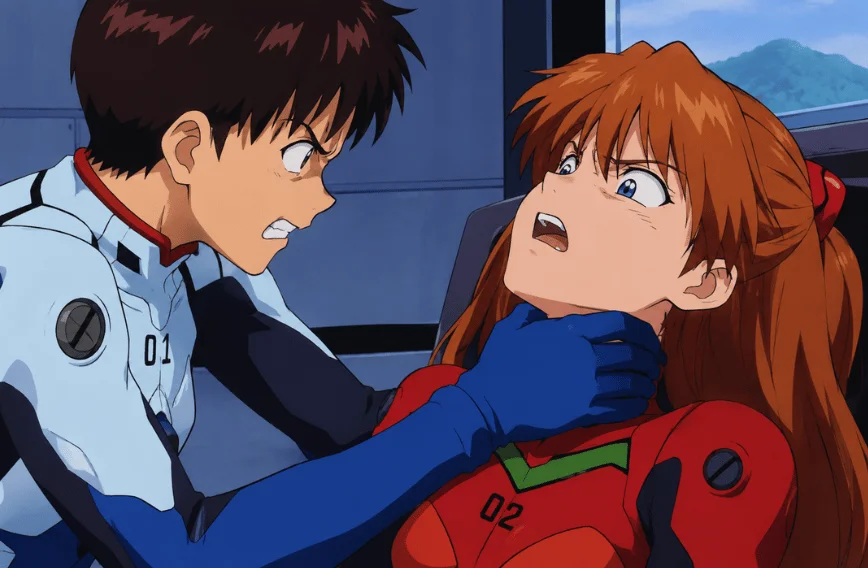
The final minutes of The End of Evangelion leave viewers with one disturbing question: why did Shinji choke Asuka? Shinji has rejected human instrumentality and returned to a world where individual people can exist again. He then finds Asuka beside him and suddenly places his hands around her neck.
The scene isn’t presented with a single spoken explanation. Still, evidence from the film and related Evangelion material points toward a strong interpretation. Shinji is confronting the frightening reality of another person who can reject, hurt, comfort, and surprise him.
Quick Facts About Shinji and Asuka’s Final Scene
| Question | Short answer |
|---|---|
| Where does the scene happen? | On a beach after Shinji rejects Instrumentality |
| Why does Shinji strangle Asuka? | He appears to confirm that she exists as a separate person who can reject him. |
| Is anger also involved? | Yes, their earlier conflict makes anger and fear relevant. |
| Why does Asuka touch his face? | Her unexpected gesture shows independent human contact and recognition. |
| Why does Shinji stop? | Her touch breaks the violent moment, and he begins crying. |
| What does Asuka say afterward? | She ends the film with “Kimochi warui,” translated in different ways. |
| Is there one official interpretation? | No. The ending deliberately leaves room for interpretation |
Direct answer: Shinji chokes Asuka after rejecting Instrumentality because he has returned to a world of separate individuals. The act can be read as a disturbing test of whether Asuka truly exists independently from him. Her unexpected touch confirms that she can respond by her own choice, so Shinji stops and cries.
Why Did Shinji Choke Asuka at the End of Evangelion?

The clearest explanation starts with Shinji’s decision to reject human instrumentality. Instrumentality removes the boundaries separating individual human beings. Shinji eventually chooses an imperfect reality where people remain separate, even though separation allows rejection and emotional pain.
That choice makes Asuka’s presence on the beach especially important. She isn’t simply someone Shinji knows from NERV. She represents one of the most difficult human relationships he has experienced.
An official-era Evangelion trading card provides important support for this interpretation. Its explanation says Shinji chose a world containing other hearts that could reject or deny him. It connects his hands around Asuka’s neck, confirming the existence of such an “other.”
The strangling therefore isn’t best understood as a simple revenge scene. It demonstrates the frightening consequences of Shinji’s decision to restore individuality. A separate Asuka can resist him, reject him, surprise him, or offer affection.
Instrumentality Explains Why the Scene Matters
Human Instrumentality attempts to eliminate the barriers between people. Individual identities and emotional boundaries disappear within that condition. The loneliness caused by being separate is removed, but meaningful individuality disappears with it.
Shinji ultimately decides that this painless unity isn’t the existence he wants. He accepts a reality where individual people can return. That choice also means accepting uncertainty, loneliness, disagreement, and rejection.
The beach immediately puts that decision to the test. Shinji isn’t greeted by an ideal companion who automatically understands him. Instead, he encounters Asuka, whose relationship with him has always mixed attraction, resentment, insecurity, and failed communication.
This makes her an especially meaningful first person for him to encounter. She represents exactly what Instrumentality removed: an independent person he cannot control. Her existence proves that returning to reality carries both hope and pain.
The Earlier Choking Scene Changes the Meaning
The beach isn’t the first time viewers see Shinji strangle Asuka in the film. During the psychological sequences surrounding instrumentality, the pair have another bitter confrontation. Shinji begs for emotional help, while Asuka rejects the way he seeks affection from her.
His desperation quickly turns into rage. He destroys objects around him before attacking her within the surreal sequence. That earlier moment connects strangling with Shinji’s fear of rejection and inability to communicate.
The final scene deliberately recalls that confrontation. This time, however, the setting has changed from an internal psychological space to the restored physical world. Asuka can respond as a separate person rather than as part of Shinji’s inner experience.
That parallel suggests several emotions can exist at once. Shinji can be testing reality while also carrying anger toward her. Evangelion rarely reduces its characters to one clean motivation.
Why Does Asuka Caress Shinji’s Face?
Asuka’s response makes the ending far more complicated. She doesn’t initially answer his violence with another attack. Instead, she raises her hand and gently touches his face.
That gesture matters because it isn’t the response Shinji controls. Asuka chooses it herself. Her independent action gives Shinji the human contact he repeatedly sought but could never demand successfully.
The touch can therefore function as proof that she is genuinely separate from him. She can make a choice he didn’t predict. She can also respond to violence with a brief moment of tenderness without erasing their troubled history.
Shinji immediately releases her and begins crying. His reaction suggests that something about her touch breaks through his aggression. Human connection has returned, but it remains painful and uncertain.
What Does Asuka’s “How Disgusting” Mean?
Asuka’s final Japanese words are “Kimochi warui.” English renderings have included phrases such as “How disgusting” and “I feel sick.” The wording ends the movie without giving viewers a comforting reconciliation.
Her reaction fits the larger meaning of the beach scene. Asuka has returned as an independent person with her own feelings and judgments. She can offer tenderness one moment and express disgust the next.
That contradiction is central to the ending rather than a flaw in it. Human relationships don’t provide the automatic acceptance offered by Instrumentality. People can care about each other while remaining angry, uncomfortable, or deeply hurt.
The final line also prevents the scene from becoming a simple romantic resolution. Asuka’s touch doesn’t mean every conflict between them has disappeared. Both characters return to a reality where connection remains difficult.
Is Shinji Trying to Kill Asuka?
The film shows a genuine act of violence, so describing the moment only as a harmless “reality test” would oversimplify it. Shinji applies his hands to her neck until her response causes him to stop. His earlier psychological confrontation also establishes that anger toward Asuka is part of his emotional state.
Yet the ending doesn’t clearly present a straightforward murder attempt either. The official-era card explanation connects his action with confirming another person’s existence and capacity for rejection. That context gives the act a symbolic function beyond simple homicidal intent.
The safest reading combines those elements instead of choosing only one. Shinji’s action expresses fear, hostility, emotional desperation, and his confrontation with individuality. The violence shows how badly damaged his relationship with other people remains.
Why Asuka Is the Person Beside Shinji
Asuka is particularly suited to the final scene because she challenges Shinji throughout the story. Both characters want affection, yet both struggle to communicate their needs. Their interactions repeatedly move between attraction, competition, resentment, and vulnerability.
She also refuses to become a convenient source of unconditional approval. That makes her a powerful contrast to Instrumentality. Shinji has chosen a reality containing people whose responses don’t exist solely for his comfort.
Her presence therefore gives his philosophical choice immediate consequences. He wanted other people to exist again. Now he must live beside someone who can reject him.
Readers exploring other pop-culture topics can browse Smagazinego’s Entertainment section coverage for related film, television, and fandom features. The site’s guide explaining UwU and online fandom language also provides useful context for expressions common across anime communities. Gaming readers can explore its iPad games coverage for more entertainment content.
The Ending Is About the Cost of Human Connection
The beach sequence makes Shinji’s rejection of Instrumentality tangible. Choosing individuality sounds hopeful in theory. Living with another independent person is much harder.
Other people can comfort you, but they can also reject you. They can understand part of you while misunderstanding another part. You cannot completely control what they think, feel, or do.
Asuka demonstrates all three possibilities within seconds. She receives Shinji’s violence, responds with an unexpected touch, and then voices disgust. Her behavior confirms that she remains herself.
Shinji’s tears complete the moment. He has regained the painful human world he chose. Connection is possible again, but guaranteed acceptance is not.
Does the Final Scene Have One Correct Meaning?
The End of Evangelion deliberately encourages interpretation rather than supplying a simple answer. Several readings can coexist because the characters enter the scene carrying years of fear and emotional conflict. The symbolic explanation doesn’t cancel the psychological one.
The “confirming another person” interpretation has stronger textual support than many fan theories. Related official-era material explicitly connects the strangling with Shinji confronting an independent other. Still, the film’s presentation leaves the emotional mixture open to discussion.
That ambiguity helps explain why the ending remains debated decades later. The scene isn’t asking viewers to excuse Shinji’s violence. It uses that violence to show how frightening and difficult separation from other people can become.
Frequently Asked Questions
Why did Shinji choke Asuka instead of talking to her?
Shinji has repeatedly struggled to communicate his emotional needs directly. His behavior on the beach continues that destructive pattern after Instrumentality ends. The act also tests whether Asuka exists independently and can respond to him.
Why did Shinji choke Asuka twice?
The two scenes mirror each other but occur under different conditions. The earlier sequence connects the violence with rejection and anger during Instrumentality. The beach repeats the action after individuality returns, giving Asuka an independent response.
Why does Shinji stop choking Asuka?
Asuka unexpectedly reaches up and touches his face. Shinji then releases her and starts crying. Her independent gesture can be understood as confirmation that another person truly exists again.
Does Asuka forgive Shinji at the end?
The movie never states that she forgives him. Her gentle touch suggests compassion or recognition, but her final words preserve discomfort and rejection. Treating the scene as complete forgiveness removes much of its deliberate tension.
What does “Kimochi warui” mean in The End of Evangelion?
The Japanese expression conveys strong discomfort or disgust depending on context. English versions have rendered it in different ways, including “How disgusting” and “I feel sick.” Its ambiguity suits a scene built around conflicting human emotions.
Final Takeaway
So, why did Shinji choke Asuka? The strongest supported interpretation is that he is confronting the return of genuine individuality after rejecting Instrumentality. Asuka’s existence means another human can reject him, hurt him, comfort him, and behave in ways he cannot control.
The scene also carries Shinji’s anger, fear, and unresolved history with her. Asuka’s touch proves that human connection remains possible, while her final words show that connection doesn’t guarantee acceptance. That uncomfortable combination is precisely what makes The End of Evangelion’s ending so memorable.