

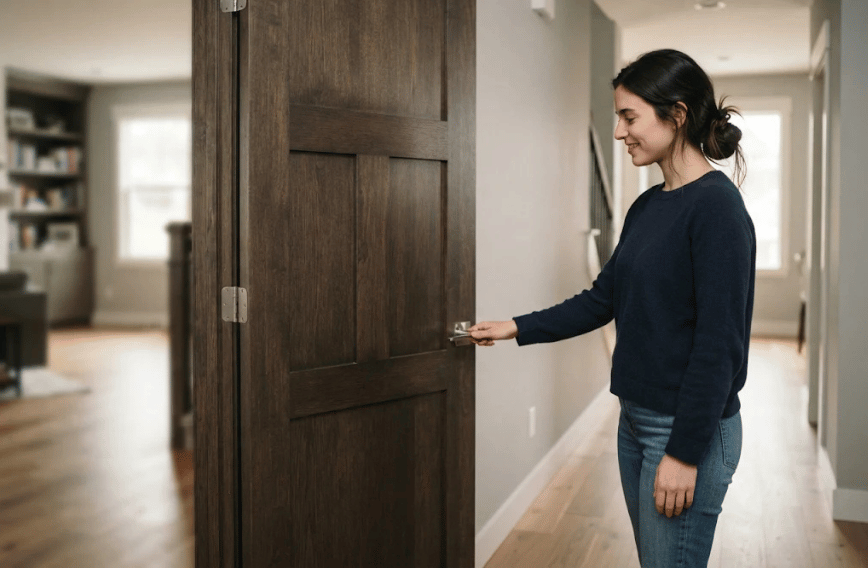
A solid core door gives an interior doorway more weight, durability, privacy, and sound control than a hollow-core alternative. It usually contains dense engineered wood, particleboard, MDF, or another filled material beneath its finished surface. For many U.S. homeowners, it offers a practical middle ground between hollow-core and solid-wood doors. The heavier construction makes these doors useful in bedrooms, bathrooms, offices, laundry rooms, and other noise-sensitive spaces. They usually cost more and require stronger hardware than lightweight doors. Still, the added privacy and substantial feel can justify the expense in selected rooms. Quick answer: Solid-core interior doors contain dense material instead of a mostly hollow honeycomb structure. Their extra mass improves sound reduction, durability, privacy, and the way the door feels when closing. They cost and weigh more than hollow-core models, so selective upgrades often provide the best value.
Solid Core Door Facts at a Glance
| Feature | Solid-Core Interior Door | Hollow-Core Interior Door |
|---|---|---|
| Core construction | Dense engineered wood or composite fill | Lightweight honeycomb or cellular fill |
| Sound control | Better | Limited |
| Weight | Heavy | Light |
| Durability | Higher | Lower |
| Privacy | Better | Basic |
| Installation | More demanding | Easier |
| Typical U.S. slab cost | Often about $70–$500 | Often about $30–$400 |
| Best uses | Bedrooms, offices, bathrooms, media rooms | Closets, pantries, low-priority spaces |
Cost ranges depend on size, finish, brand, hardware, and local availability. Angi reported those broad interior-door ranges in its July 2026 comparison. Installation, trim, finishing, and hardware can increase the completed project price.
What Is a Solid-Core Interior Door?

A solid-core interior door has a substantially filled center between its finished faces. Manufacturers often use particleboard, MDF, wood fiber, or other dense composite materials. The door is not necessarily made from one solid piece of natural wood. That distinction matters because solid wood is a separate door category. Solid wood usually costs more and responds differently to moisture and temperature changes. Engineered cores can provide substantial weight without requiring premium hardwood throughout the slab. The dense center also gives screws and hardware a firmer structure to work with. That can benefit heavily used bedrooms, offices, and shared spaces. Homeowners planning a larger renovation can consider door choices during the broader home-building and finishing process.
Solid Core Door vs. Hollow Core: The Practical Differences
The biggest difference between the two designs is mass. Hollow-core doors commonly use thin face panels over a lightweight internal structure. Solid-core models fill far more of the interior with dense material. That extra material changes sound control, durability, weight, and price. It also changes how the door feels during everyday use. A heavier slab tends to close with a firmer, quieter feel than a lightweight alternative.
| Factor | Solid Core | Hollow Core |
|---|---|---|
| Noise reduction | Better because of greater mass | Lower because the core contains more air |
| Impact resistance | Better for busy rooms | More vulnerable to dents and damage |
| Door feel | Heavy and substantial | Light |
| Hardware demands | Strong hinges and secure fasteners | Standard light-duty hardware often works |
| DIY installation | More difficult | Usually easier |
| Purchase cost | Higher | Lower |
| Best strategy | Prioritize important rooms | Use where privacy matters less |
The choice does not need to be all-or-nothing. Many homes benefit from mixing both construction types. You can spend more where privacy matters and save money on closets or low-traffic openings.
Why Solid-Core Doors Reduce More Noise
Sound control improves when a barrier has enough mass to resist vibration. Dense doors generally perform better than lightweight doors for that reason. Gaps around the frame still matter, so the slab alone does not determine acoustic performance. Published technical guidance also shows a meaningful difference between common door constructions. One environmental noise guide lists typical STC values around 26 for solid-core wood doors and 20 for hollow-core wood doors. Exact results vary with the complete tested assembly. Seals can improve the result because noise readily travels through openings. A tight perimeter, suitable door sweep, and accurate frame alignment can matter as much as the slab upgrade. Home offices and bedrooms often benefit most from combining added mass with improved sealing.
Where the Upgrade Makes the Most Sense
Bedrooms are strong candidates because conversations, televisions, hallways, and early-morning activity can disturb sleep. A heavier door can reduce some of that transmission. Privacy also feels more substantial when the door closes firmly. Home offices deserve similar consideration, especially for remote workers. Calls are less likely to disturb other rooms, and surrounding household sounds become less distracting. This benefit can matter in smaller U.S. homes where workspaces sit near living areas. Bathrooms can also benefit from greater sound privacy. A den, media room, nursery, or laundry room may deserve the same treatment. Closets and utility spaces usually offer less return from the additional cost. Hardware selection also matters on heavier doors. Privacy locks, hinges, and latches should suit the door’s intended use. Smagazinego’s guide to interior door knobs with locks explains common privacy and keyed hardware options.
How Much Does a Solid-Core Door Cost in the U.S.?
Current pricing varies widely because doors come in different dimensions, finishes, designs, and supply formats. Angi lists solid-core interior doors at roughly $70 to $500. Premium styles, custom dimensions, prehung assemblies, and professional labor can raise the total. The slab price is only part of a replacement project. You may also need hinges, a lockset, paint, casing repairs, disposal, or frame adjustments. Labor varies by market and becomes more important when several doors are replaced. A selective plan often gives homeowners better value than replacing every interior door. Upgrade bedrooms and other privacy-sensitive rooms first. Keep serviceable hollow-core doors where acoustic performance and impact resistance matter less.
Slab Door or Prehung Door?
A slab is the door itself without a new frame. It can work when the existing jamb remains square and structurally sound. Accurate hinge and latch placement are essential when fitting a replacement slab. A prehung unit includes the door already mounted within a frame. It usually makes more sense when the old frame is damaged, misaligned, or being removed during remodeling. The larger assembly can increase material and labor costs. Homeowners planning purchases should compare the condition of the entire opening before choosing. That same habit helps during larger property decisions. Smagazinego’s tips for finding an ideal home also stress matching features with practical long-term needs.
Installation Requires More Attention
Weight is the main installation challenge. A dense interior slab can be awkward for one person to carry, position, and align. Poor alignment can cause rubbing, latch problems, or stress on hinges. Manufacturers may specify three hinges or other hardware for heavier products. Always follow the instructions supplied with the selected door. The existing jamb must also be capable of supporting the finished assembly. DIY installation is possible for experienced homeowners with proper tools. Less experienced homeowners may find professional installation worthwhile. A correctly hung door protects the hardware and helps preserve consistent gaps around the frame.
Are Solid-Core Doors Fire-Rated?
A dense core does not automatically make a door fire-rated. Fire resistance applies to a tested and labeled door assembly built for a specific rating. Construction alone should never be used to assume code compliance. Some manufacturers offer solid-core products with tested fire ratings. Others make ordinary interior versions without that certification. Check the product label and documentation whenever a building code requires a rated opening. This distinction is especially important around garages and other regulated locations. Local building requirements can differ, so verify the applicable code before buying. Use a listed assembly when a fire rating is required.
Is a Solid-Core Door Worth the Extra Cost?
For every opening in a house, probably not. For bedrooms, bathrooms, offices, nurseries, and other high-priority spaces, the value can be much stronger. Those rooms benefit most from privacy, quieter operation, and greater impact resistance. A room-by-room strategy also keeps remodeling costs under control. Start with the doors causing the biggest privacy or noise problems. You can upgrade additional openings later if the difference is worth it. You’ll notice the improvement most in daily use. A heavier door feels more substantial and resists minor impacts better. It can also make adjoining rooms feel more separated without changing their layouts.
What to Check Before Buying
Use the room’s needs rather than appearance alone when comparing products. Two painted doors can look almost identical while behaving differently. Construction, dimensions, ratings, and hardware requirements should guide the final choice. Before ordering, check these points:
* Confirm the exact rough opening or slab dimensions. * Decide whether you need a slab or prehung assembly. * Check hinge requirements for the door’s weight. * Verify any claimed fire or acoustic rating. * Choose privacy or passage hardware for the room. * Review how much trimming the manufacturer allows. * Include installation and finishing costs in your budget.
Measure twice because return policies can be restrictive on cut or finished products. Keep the manufacturer’s installation instructions for reference. They are more reliable than assumptions based on another door model.
Frequently Asked Questions
What is a solid core door made of?
A solid core door commonly uses particleboard, MDF, wood fiber, or another dense engineered material inside its faces. Construction varies between manufacturers and product lines. It should not be confused with a door made entirely from natural solid wood.
Are solid-core doors completely soundproof?
No standard residential interior door is completely soundproof. Dense doors usually block more sound than lightweight hollow-core models. Seals, gaps, wall construction, and installation quality also affect the result.
Do solid-core doors need special hinges?
They may need heavier or additional hinges because their slabs weigh more. Manufacturer instructions should determine the correct hardware. Secure fastening into a suitable frame is important for long-term alignment.
Can I replace a hollow-core door with a solid-core one?
Yes, provided the existing frame can support the heavier slab. Hinge locations, latch placement, dimensions, and jamb condition must match. A carpenter can correct alignment problems when the old opening is unsuitable.
Are solid-core doors better for bedrooms?
They are often a good bedroom choice because they provide better sound reduction and a more substantial barrier. That can improve privacy around busy hallways or shared living areas. Bedrooms are among the first places worth considering during selective upgrades.
How long can a solid-core interior door last?
Service life depends on construction, installation, moisture exposure, hardware, and household use. Dense doors generally resist everyday damage better than lightweight alternatives. Proper hinge support and routine hardware maintenance can extend useful life.
Choosing the Right Doors for Your Home
The smartest approach is usually selective rather than universal. Spend more on doors serving bedrooms, bathrooms, offices, and other rooms where privacy matters. Keep lower-cost options in areas where weight and sound control offer little practical benefit. Compare the complete opening before ordering anything. Check the slab, frame, hinges, lockset, ratings, finish, and labor together. That prevents an inexpensive door purchase from becoming an unexpectedly costly project. For most U.S. homeowners, the decision comes down to priorities. Choose added mass where quieter rooms and durability matter most. A well-planned mix of door types can improve comfort without overspending. —