
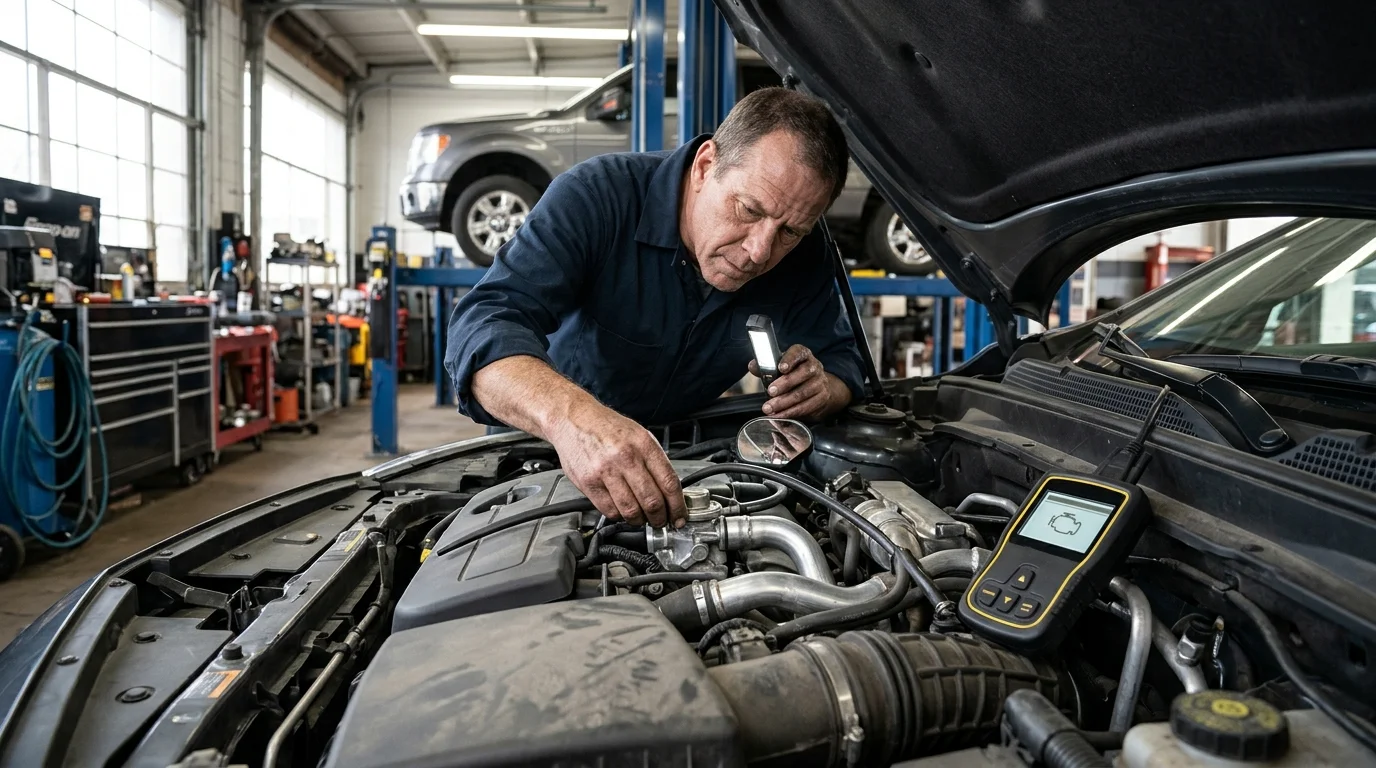
A P0402 code means your vehicle detects more exhaust gas recirculation flow than expected. The problem usually involves the EGR system, its controls, or its feedback sensors. You should diagnose the cause before replacing an expensive EGR valve.
Quick answer: P0402 means “Exhaust Gas Recirculation Flow Excessive Detected.” The engine computer sees more EGR flow than its programmed target. Common causes include a stuck EGR valve, carbon deposits, a faulty pressure sensor, vacuum-control problems, wiring faults, or incorrect airflow readings.
| Key fact | What U.S. drivers should know |
|---|---|
| Code | P0402 |
| System | Exhaust Gas Recirculation, or EGR |
| Basic meaning | The computer detects excessive EGR flow |
| Typical severity | Moderate, but symptoms can make driving unsafe |
| Common symptoms | Check-engine light, rough idle, hesitation, stalling, poor performance |
| Possible causes | Stuck valve, carbon, sensor fault, vacuum issue, wiring, airflow problem |
| First step | Read freeze-frame and related codes before replacing parts |
| Can you drive? | Often briefly, unless the engine stalls or runs severely rough |
| Emissions concern | The fault can affect emissions testing and readiness |
| Best repair approach | Test the system and repair the confirmed cause |
Key Takeaways
- Excessive EGR flow does not automatically mean the EGR valve needs replacement.
- A valve stuck partly open is one common cause.
- Pressure-feedback, MAP, MAF, wiring, and vacuum faults can produce similar symptoms.
- Freeze-frame and live scan data can prevent unnecessary parts replacement.
- Severe stalling, hesitation, or poor drivability deserves prompt professional attention.
- A stored emissions code can also create problems during required state inspections.
What Does P0402 Mean?
The EGR system sends controlled exhaust gas back into the engine’s intake. This process helps control combustion temperature and nitrogen-oxide emissions. The computer expects EGR flow to stay within a calculated operating range.
The code appears when measured EGR activity exceeds that expected range. Different vehicles determine flow using different sensors and strategies. Some use pressure feedback, while others rely on manifold pressure, airflow, or valve-position data.
That distinction matters when diagnosing the problem. A sensor can report excessive flow even when the valve itself remains usable. Replacing parts based only on the code can waste money.
The U.S. Environmental Protection Agency explains that onboard diagnostics monitor emissions-related systems. These systems store diagnostic trouble codes when monitored conditions indicate a malfunction. The check-engine light can therefore appear before a driver notices severe symptoms.
What the EGR System Does
Exhaust gas recirculation lowers combustion temperatures by returning controlled exhaust gases to the intake. Those gases displace part of the fresh intake charge during suitable operating conditions. This helps limit nitrogen-oxide formation without constantly reducing engine performance.
The valve should open and close according to engine load and operating conditions. Excessive flow can dilute the intake charge when the engine needs more fresh air. Idle quality and throttle response can suffer when that happens.
Drivers interested in broader automotive engineering can browse Smagazinego’s Automobile section. It covers powertrains, performance, efficiency, and vehicle technology. Those topics help explain how emissions systems interact with modern engine controls.
Common Symptoms of Excessive EGR Flow
Symptoms depend on the engine, EGR design, and how far actual flow differs from commanded flow. A lightly affected vehicle may show only a check-engine light. A badly affected engine can become difficult to drive at low speeds.
Watch for these possible signs.
- An illuminated check-engine or service-engine-soon light.
- Rough or unstable idle.
- Engine hesitation during acceleration.
- Reduced engine power.
- Stalling at idle or during deceleration.
- Poor throttle response.
- Reduced fuel economy in some cases.
- Failed or delayed emissions inspection.
- Other stored EGR or airflow-related codes.
A rough idle is especially useful diagnostic information. Too much exhaust gas can reduce the fresh-air charge available for stable combustion. The resulting symptoms can resemble ignition, fueling, or intake-air problems.
Most Likely Causes
A stuck-open EGR valve is one possible cause, but it isn’t the only explanation. Carbon deposits can prevent the valve from seating completely. Mechanical wear can also stop the valve from following commanded positions correctly.
Sensor problems deserve equal attention. Some systems use pressure sensors to estimate the amount of recirculated exhaust gas. A biased or damaged sensor can make normal flow appear excessive.
Vacuum-operated systems add another group of possible faults. A failed control solenoid can apply vacuum at the wrong time. Damaged hoses or incorrect routing can also affect valve operation.
Electrical systems can develop connector or wiring problems. Corrosion, damaged terminals, or chafed wiring may distort control and feedback signals. A technician should inspect these items before condemning major components.
Airflow measurements can create another diagnostic path. A contaminated or inaccurate mass-airflow sensor can alter the computer’s EGR calculations. Manufacturer-specific testing is important because monitoring methods differ between vehicles.
How to Diagnose the Code Correctly
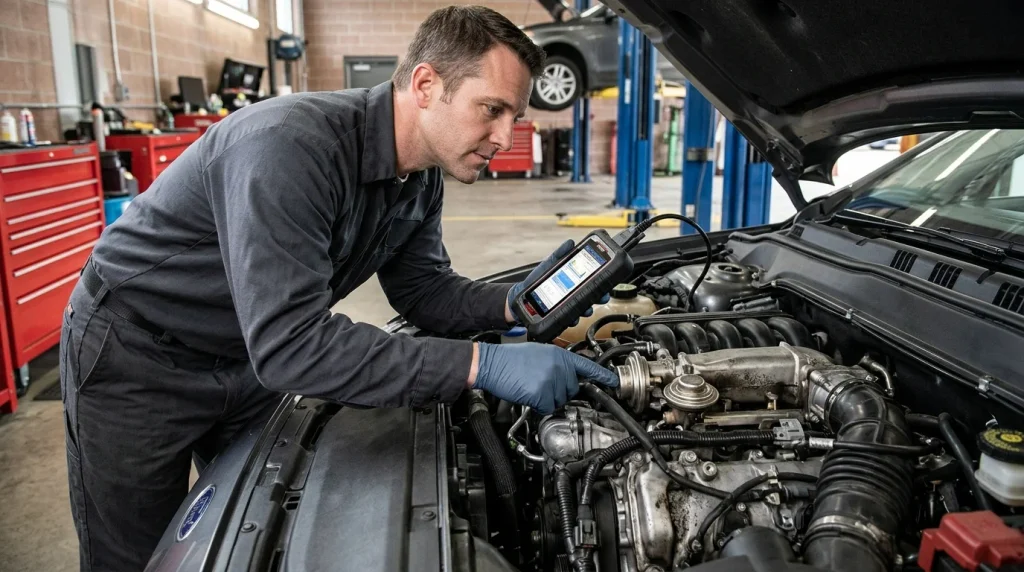
Start with a full scan instead of erasing the fault immediately. Record stored, pending, and related codes before changing anything. Save the freeze-frame information showing conditions when the fault appeared.
A practical diagnostic sequence looks like this:
1. Confirm the code. Scan every available powertrain code and save freeze-frame data.
2. Check related faults. Look for MAF, MAP, EGR-position, pressure-sensor, or circuit codes.
3. Inspect the system. Examine connectors, wiring, vacuum hoses, and visible EGR components.
4. Review live data. Compare commanded EGR operation with actual feedback values.
5. Command the valve. Use a capable scan tool when the vehicle supports bidirectional testing.
6. Inspect for deposits. Check whether carbon prevents the valve from closing correctly.
7. Test sensors. Verify pressure, position, MAP, or airflow readings against service specifications.
8. Repair the confirmed fault. Clean, repair, or replace only the component that fails testing.
9. Clear and verify. Complete an appropriate drive cycle and confirm the fault does not return.
The principle is simple: a trouble code identifies a monitored condition, not a guaranteed failed part. That approach can save considerable diagnostic time and repair cost. It also reduces the risk of replacing a good valve.
This matters on older Ford applications, where EGR pressure-feedback problems have historically come with related trouble codes. Manufacturer service information should always take priority over a generic parts list. Vehicle year, engine, and emissions package can change the correct test procedure.
Can You Drive With This EGR Fault?
Many vehicles remain drivable for a short period with excessive EGR flow. That does not mean every affected vehicle is safe to continue driving. Engine behavior should determine how urgently you respond.
A steady check-engine light with normal drivability usually allows cautious travel to a repair facility. Avoid unnecessary long trips until you know what caused the fault. Continued operation can also complicate emissions readiness or inspection requirements.
Stop driving if the engine repeatedly stalls or loses substantial power. Stalling while entering traffic can create an immediate road hazard. Severe shaking, flashing warning lights, or additional critical warnings also require prompt attention.
Will the Vehicle Fail an Emissions Test?
The answer depends on your state’s inspection program and the vehicle’s readiness status. Many U.S. inspection programs use OBD information on eligible model years. An active malfunction indicator light can prevent a passing result.
The EPA describes OBD systems as monitors for emissions-related faults. The vehicle stores diagnostic information when a monitored system reports a qualifying problem. Clearing codes immediately before an inspection can also reset readiness monitors.
Readiness matters because monitors need suitable driving conditions before testing completes. Erasing a code is therefore not the same as repairing its cause. The warning may return after the system reruns its EGR monitor.
How Much Can the Repair Cost?
There is no single repair price because the code does not identify one failed component. Cleaning deposits can cost far less than replacing a difficult-to-access valve. Wiring diagnosis or sensor replacement creates a different labor and parts bill.
Current U.S. parts pricing also varies widely between vehicles. An EGR valve can range from a relatively inexpensive component to several hundred dollars before labor. Access requirements may increase the installed cost substantially.
The safest budgeting approach is to pay for diagnosis before approving major parts. Ask the shop which test proved the suspected component failed. A clear test result is more useful than an estimate based only on the fault code.
Cleaning Versus Replacing the EGR Valve
Cleaning makes sense when deposits prevent an otherwise functional valve from closing. The component should still respond correctly after deposits are removed. Damaged electronics, motors, position sensors, or valve mechanisms usually require another repair.
Replacement makes more sense when testing confirms mechanical or electrical failure. It also makes sense when manufacturer service information specifies replacement for the measured fault. Guessing based on visible carbon alone can lead to repeat repairs.
For readers comparing different vehicle technologies, Smagazinego’s Kia Sorento PHEV review explains another approach to efficiency. Hybrid powertrains manage emissions and fuel use differently from older conventional engines. The comparison shows how rapidly engine-control systems have changed.
Why Make and Model Matter
Generic OBD-II terminology provides a common starting point across U.S. vehicles. The actual monitoring strategy remains dependent on the manufacturer and engine design. That difference can change which sensor deserves testing first.
One vehicle may infer EGR flow from intake-manifold pressure. Another may use mass-airflow changes or a dedicated differential-pressure sensor. Newer systems may monitor valve position directly alongside other airflow data.
Manufacturer technical service bulletins can also reveal known patterns. Search by VIN, model year, engine, and emissions configuration before buying parts. A bulletin can identify revised sensors, calibration changes, or vehicle-specific diagnostic steps.
Smagazinego’s 2024 Ford F-150 guide shows how widely powertrains can differ within one vehicle family. Electric, turbocharged, and V8 models use completely different emissions strategies. Accurate vehicle identification therefore matters before any diagnostic work begins.
Mistakes to Avoid
The costliest mistake is treating the code as a direct instruction to replace the EGR valve. Scan-tool definitions describe the detected condition instead. Testing must still identify why the condition occurred.
Avoid these common errors.
- Replacing the valve without testing feedback sensors.
- Clearing freeze-frame information before recording it.
- Ignoring related airflow or pressure codes.
- Overlooking damaged vacuum hoses or electrical connectors.
- Cleaning a valve with confirmed electronic failure.
- Ignoring manufacturer-specific service information.
- Clearing codes immediately before an emissions inspection.
Another mistake is assuming the vehicle must have obvious drivability symptoms. OBD systems can detect emissions-related faults before the driver notices major changes. A seemingly normal vehicle can still require diagnosis.
When to Call a Professional
Basic visual inspection and code reading are reasonable for many owners. Advanced testing often needs live data, wiring diagrams, specifications, and bidirectional scan functions. Those tools help separate mechanical flow problems from false sensor readings.
Choose a technician familiar with emissions diagnostics rather than requesting a specific replacement part. Describe every symptom and provide the complete code list. Ask what test will confirm the proposed repair.
Car enthusiasts can also explore Smagazinego’s fastest-car engineering guide for more automotive technology coverage. Performance engineering depends heavily on precise airflow and engine management. The same principle makes accurate diagnosis important on everyday vehicles.
Frequently Asked Questions
What causes P0402 most often?
A valve that remains open can produce excessive EGR flow, especially during idle conditions. Carbon deposits may prevent the valve from seating correctly. Sensors, vacuum controls, wiring, or airflow readings can also cause the detected condition.
Can a bad MAF sensor cause excessive EGR readings?
It can on systems that use airflow changes when calculating EGR performance. Incorrect MAF information may distort the computer’s estimate of recirculated gas. Always follow the diagnostic strategy for your exact vehicle.
Will cleaning the EGR valve fix the problem?
Cleaning may work when carbon prevents a functioning valve from closing fully. It will not repair failed electronics, damaged wiring, or a defective feedback sensor. Test the system before deciding that cleaning is enough.
Can I clear the code and keep driving?
You can clear stored information with a scan tool, but that does not repair the fault. The code can return when the monitor runs again. Clearing codes also resets readiness information on many vehicles.
Is excessive EGR flow dangerous?
The emissions fault itself is not automatically an emergency. The resulting drivability symptoms can create safety concerns. Repeated stalling or major power loss should be treated promptly.
What should I tell a repair shop?
Give the technician the complete trouble-code list and describe when symptoms occur. Mention whether problems appear at idle, during acceleration, or after warm-up. Ask for the test results that identify the failed component.
The Bottom Line
The safest response to an excessive-EGR-flow warning is diagnosis before parts replacement. A stuck valve is possible, but sensors and control faults can produce similar results. Freeze-frame data, live readings, and manufacturer procedures help separate those causes.
Address the issue before an emissions inspection or before drivability becomes worse. Stop driving if stalling or serious power loss creates a traffic risk. Otherwise, arrange a proper diagnostic check and repair the confirmed fault.