

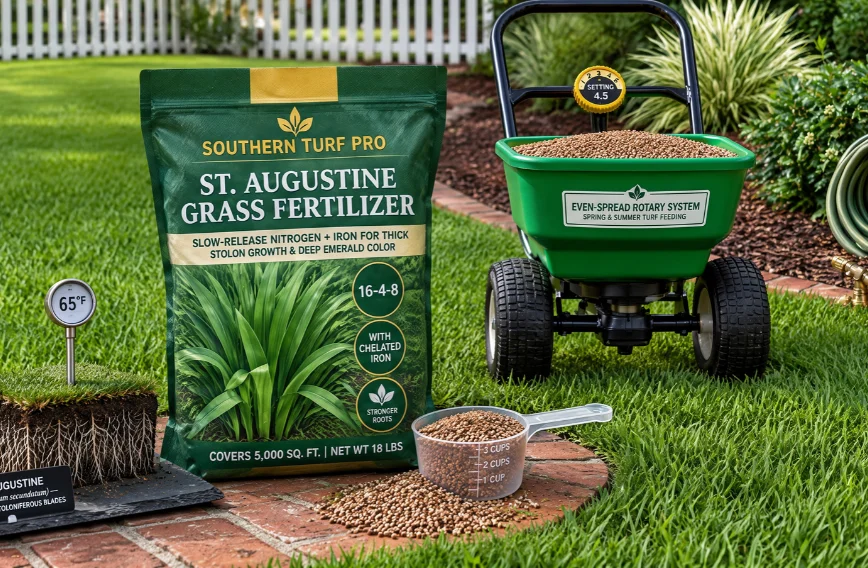
Choosing the right fertilizer for St. Augustine grass starts with nitrogen, timing, and your local growing season. Most established lawns need fertilizer only while the turf is actively growing. A soil test should guide phosphorus and potassium choices whenever possible.
Quick answer: Feed established St. Augustine lawns after spring green-up, not while the turf is dormant. Choose mostly slow-release nitrogen and avoid unnecessary phosphorus unless a soil test shows a need. Application rates and schedules vary across the southern United States, so local extension guidance and fertilizer rules should shape your final plan.
St. Augustine Lawn Fertilizer at a Glance
| Question | Practical guidance |
|---|---|
| Best fertilizer type | Slow-release nitrogen fertilizer suited to warm-season turf |
| Common N-P-K choices | 15-0-15, 16-4-8, or another soil-test-based formula |
| First application | After active spring growth begins |
| Annual nitrogen | Commonly about 1–4 pounds per 1,000 square feet, depending on region and conditions |
| Phosphorus | Add only when soil testing or local guidance supports it |
| Summer color | Iron may improve color without pushing excessive growth |
| Final feeding | Usually several weeks before expected frost |
| New sod | Allow roots to establish before routine fertilization |
| Main mistake | Applying too much nitrogen or feeding dormant turf |
Key Takeaways
- Wait for active spring growth before the first nitrogen application.
- Use a soil test before choosing a fertilizer containing significant phosphorus.
- Slow-release nitrogen provides steadier feeding and lowers the risk of rapid growth.
- Calculate applications using pounds of actual nitrogen, not pounds of fertilizer.
- Reduce feeding in shade, during drought stress, and near seasonal dormancy.
- Check state, county, and city fertilizer rules before spreading fertilizer.
How to Choose Fertilizer for St. Augustine Grass
The best fertilizer for St. Augustine grass is not always the bag with the highest nitrogen number. Your lawn needs enough nitrogen to maintain healthy growth without producing excessive leaves and thatch. Soil conditions, sunlight, rainfall, and growing-season length all affect that amount.
A slow-release nitrogen source is usually a practical choice for routine maintenance. It releases nutrients over time instead of creating a short growth surge. That steadier release can also reduce the risk of fertilizer burn when you follow the label.
Phosphorus deserves extra attention because established turf may not need additional amounts. A soil test can show whether your lawn needs phosphorus or other nutrients. Several states and local governments also restrict phosphorus applications to protect waterways.
Potassium supports stress tolerance and becomes useful when soil testing indicates a need. Products such as 15-0-15 are common where phosphorus is unnecessary. A balanced formula can make sense when testing confirms several nutrient deficiencies.
Understanding the Three Numbers on the Fertilizer Bag
Every fertilizer label shows three numbers representing nitrogen, phosphate, and potash percentages. A 15-0-15 product contains 15 percent nitrogen and 15 percent potash. The middle zero shows that it contains no phosphate.
Nitrogen drives green leaf growth and helps turf recover during its active season. Too much nitrogen can create soft growth that needs frequent mowing. Excessive feeding can also increase thatch and disease pressure.
The numbers also help you calculate how much product your lawn needs. Ten pounds of a 10-percent nitrogen fertilizer contains one pound of actual nitrogen. The same nitrogen amount requires only five pounds of a 20-percent nitrogen product.
How Much Nitrogen Does the Lawn Need?
There is no single national nitrogen rate because growing seasons differ across the United States. Texas A&M notes that annual needs can range from roughly one to four pounds per 1,000 square feet. Other extension programs publish region-specific schedules within similar ranges.
Start at the lower end when your lawn already looks healthy and grows steadily. Shaded lawns often need less nitrogen than turf receiving full sun. Returning grass clippings can also recycle nutrients into the soil.
Higher rates do not automatically produce a healthier lawn. Rapid growth can mean more mowing, more water use, and greater disease pressure. Watch the turf response instead of feeding only because a calendar says another application is due.
Simple Fertilizer Calculation Example
Suppose your lawn measures 5,000 square feet and you want 0.5 pound of nitrogen per 1,000 square feet. You need 2.5 pounds of actual nitrogen for the entire lawn. With a 20-percent nitrogen fertilizer, divide 2.5 by 0.20 to get 12.5 pounds of product.
Always compare your calculation with the fertilizer label before application. Some products contain quick-release and slow-release nitrogen in different proportions. Local rules may also limit the amount allowed in one application.
When to Fertilize St. Augustine Lawns
Spring green-up matters more than a fixed national date. Apply fertilizer after the lawn is actively growing and late frost risk has passed. Texas A&M recommends waiting until the turf has been mowed at least twice after spring growth begins.
Florida timing varies considerably because the state covers several growing zones. UF/IFAS generally places first applications around early April in central Florida and mid-April farther north. South Florida can support a much longer feeding season because growth can continue through winter.
Farther north, the growing season becomes shorter. Clemson advises warm-season turf owners to concentrate fertilization during the warmer growing months. Your county extension office can provide dates suited to local temperatures and frost patterns.
The final nitrogen application also requires careful timing. Texas A&M recommends stopping roughly four to six weeks before the historic first frost. Late nitrogen can encourage tender growth when the lawn should prepare for colder weather.
A Practical U.S. Feeding Schedule
| Region | First feeding | Main season | Final feeding |
|---|---|---|---|
| South Florida | Based on active growth and local rules | Extended or year-round growth | Follow local regulations |
| Central Florida | Around spring green-up | Spring through fall where permitted | Before cooler-season slowdown |
| North Florida | After reliable spring green-up | Spring through early fall | Before late-season growth ends |
| Gulf Coast and Texas | After active green-up and several mowings | Late spring through summer | 4–6 weeks before expected frost |
| Coastal Carolinas | After full spring green-up | Mainly late spring and summer | Before late-summer or fall cutoff |
These windows provide a starting point rather than a universal calendar. Weather, soil, irrigation, shade, and local fertilizer ordinances can change the correct timing. Follow local extension recommendations when they differ from a general schedule.
How to Apply Lawn Fertilizer Correctly
Start by measuring the actual lawn area instead of using the entire property size. Driveways, planting beds, patios, and buildings should not count toward fertilizer coverage. Accurate measurements make both purchasing and application calculations easier.
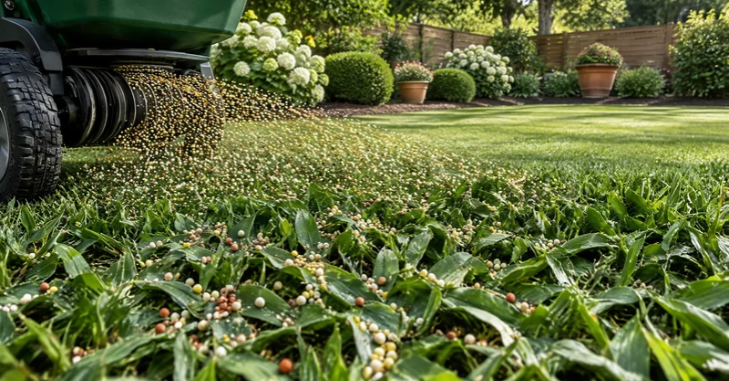
Apply granular fertilizer evenly with a properly calibrated spreader. Dividing the amount into two passes can improve coverage across irregular lawns. Make one pass lengthwise and the second across the first direction.
Keep fertilizer granules off sidewalks, streets, and driveways. Sweep stray material back onto the turf instead of washing it into storm drains. This reduces nutrient runoff and prevents waste.
Follow the product label for watering instructions after application. Many granular products need light irrigation to move nutrients toward the soil. Avoid applying before heavy rainfall because runoff can carry fertilizer away.
For more ideas about maintaining an attractive yard perimeter, see Smagazinego’s guide to creating a safe and stylish outdoor space with fencing. Lawn health and hardscape maintenance work together to improve curb appeal. Keeping fertilizer off nearby surfaces also prevents staining and unnecessary cleanup.
Why More Fertilizer Can Make the Lawn Worse
Dark green turf can look healthy, but color alone does not prove good lawn health. Excess nitrogen can push rapid leaf growth while increasing mowing requirements. It may also contribute to thatch, pest pressure, and disease problems.
A pale lawn does not always need another fertilizer application either. Iron deficiency, root problems, drought, excessive moisture, or pests can produce similar symptoms. Diagnose the cause before adding more nitrogen.
This matters especially during hot and humid weather. UF/IFAS notes that iron products can improve summer color without stimulating the same growth as nitrogen. That option can be useful where summer nitrogen applications are restricted.
General property maintenance also affects how a lawn performs. Drainage problems, construction damage, and poor grading can create symptoms that fertilizer cannot correct. Smagazinego’s article on common home restoration mistakes offers related guidance about drainage and exterior maintenance.
Should You Use Weed-and-Feed Products?
Combination products can be convenient, but convenience does not guarantee correct timing. Your lawn may need fertilizer when weeds do not need treatment. The opposite situation can also occur.
Some herbicides can injure warm-season turf when temperatures are high or the lawn is stressed. Product labels also differ in the grass species they permit. Confirm that a weed-and-feed product specifically allows use on your cultivar.
Separate treatments offer more control when weeds appear only in limited areas. Spot treatment can reduce unnecessary herbicide exposure across the whole lawn. It also lets you fertilize according to turf needs instead of weed timing.
New Sod Needs a Different Approach
Fresh sod needs roots before it needs an aggressive fertilizer program. UF/IFAS recommends delaying routine fertilization after installation while the turf establishes. Exact timing depends on season, soil, and establishment progress.
Focus first on correct irrigation and root development. Pull gently on a sod corner after several weeks to check whether roots resist lifting. Once establishment is clear, follow local extension guidance for the first feeding.
Avoid using heavy nitrogen to force rapid color during establishment. Young roots need balanced conditions rather than excessive top growth. Good establishment makes future lawn maintenance easier.
Soil Testing Can Save Money
A soil test removes much of the guesswork from fertilizer selection. It can identify soil pH and nutrient conditions that affect fertilizer performance. Testing is especially useful before adding phosphorus or attempting to correct persistent yellowing.
County extension services often provide testing instructions or laboratory access. Use the results to choose nutrients rather than relying on a familiar bag ratio. This reduces unnecessary applications and can lower yearly fertilizer costs.
Testing also prevents fertilizer from becoming the default answer to every lawn problem. Insects can create thin or damaged areas that resemble nutrient stress. Smagazinego’s guide about ground-nesting bees and lawn areas illustrates why identifying what is happening in the soil matters before treatment.
Common Fertilizing Mistakes to Avoid
Several mistakes appear repeatedly in struggling warm-season lawns. Most come from applying the right nutrient at the wrong rate or time. Avoiding them can save more money than buying a premium fertilizer.
- Feeding grass before it has fully resumed spring growth.
- Applying nitrogen during drought or severe heat stress.
- Assuming phosphorus is needed without a soil test.
- Using the same schedule in every U.S. climate.
- Applying more product than the label permits.
- Fertilizing immediately before heavy rain.
- Spreading granules onto pavement or near water.
- Continuing nitrogen too close to winter dormancy.
- Treating every yellow lawn as a nitrogen deficiency.
Fertilizer for St. Augustine Grass FAQ
What is the best fertilizer for St. Augustine grass?
A mostly slow-release nitrogen fertilizer is a strong starting choice for established turf. Select phosphorus and potassium levels using a soil test whenever possible. Products such as 15-0-15 or 16-4-8 may fit some lawns, but regional guidance takes priority.
Is 15-0-15 good for St. Augustine lawns?
A 15-0-15 fertilizer can work well where phosphorus is already sufficient. It supplies nitrogen and potassium without adding more phosphorus. Check your soil test and product label before choosing it.
Is 16-4-8 a good fertilizer ratio?
A 16-4-8 formula can provide nitrogen, phosphorus, and potassium in one product. It makes the most sense when your soil needs all three nutrients. Avoid adding phosphorus automatically when testing shows adequate levels.
How often should the lawn be fertilized?
Frequency depends on climate, fertilizer type, soil, and desired maintenance level. Slow-release products normally extend the interval between applications compared with soluble nitrogen. Follow annual nitrogen limits instead of chasing a fixed number of feedings.
Can you fertilize during summer?
Summer feeding can be appropriate while healthy turf is actively growing. Avoid heavy nitrogen during severe heat, drought stress, or periods restricted by local ordinances. Iron can sometimes improve green color without encouraging rapid leaf growth.
Should fertilizer be applied before or after rain?
Avoid spreading fertilizer shortly before heavy rainfall. Runoff can move nutrients away from the lawn and into drains or waterways. Follow the label if light irrigation is needed after application.