


You rank well at home and almost nowhere in Germany, Mexico, or Japan. Closing that gap is what international SEO services are sold to do. Every provider describes the work in the same language, and the quoted ranges are wide enough to tell you nothing. This guide prices the work market by market, compares the four realistic ways to buy it, and gives you a way to judge the first 90 days.
Short answer: expect $1,500 to $3,000 a month for one or two markets. Three to five markets run $3,500 to $8,000, and a global program starts near $10,000. That budget buys demand research, technical geo-targeting, localized content, and country-level reporting. Movement usually shows up in three to six months.
What You Are Paying For
The line items barely change between vendors. What changes is how the money splits, and that split tells you what a provider is good at. Read that split closely.
| Component | What it covers | Share of a $5,000 month |
| Market and demand research | Sizing search demand per country, mapping local competitors, building keyword sets in the local language | 10% to 15% |
| Technical geo-targeting | URL structure, hreflang, x-default, search Console settings, crawl, and index checks | 15% to 20% |
| Content localization | Rewriting pages for each market, adapting examples, currency, and offers | 30% to 40% |
| Local authority | Digital PR, partnerships, and links from publishers inside the target country | 20% to 25% |
| Reporting by market | Segmented GA4 and Search Console views, rank tracking split by country | 5% to 10% |
TL;DR
- One or two markets: $1,500 to $3,000 a month, plus a $2,000 to $4,000 setup fee.
- Three to five markets: $3,500 to $8,000 a month, with localization billed at $200 to $500 per page.
- Localization eats the largest slice of the budget, so judge a provider on writing quality first.
- Four buying models exist, and the cheapest sensible one depends on how many markets you fund.
- Ask for movement by day 90, not revenue. Revenue lands closer to month six.
What International SEO Services Actually Include
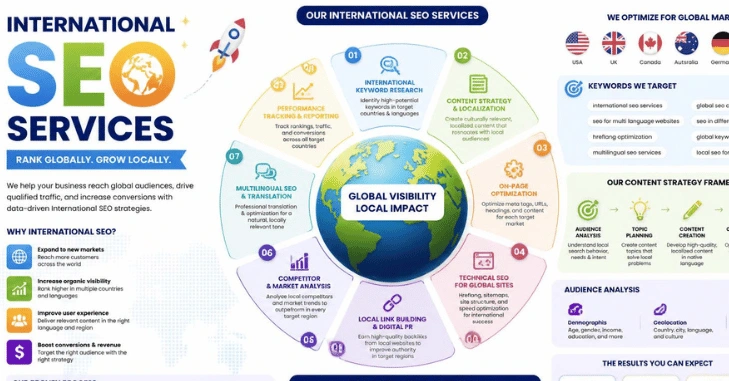
Strip away the sales copy and the work is three jobs stacked on each other. Search engines have to understand which version of a page belongs to which country. Readers in that country have to find copy that sounds like it was written for them. And the site has to earn links and mentions from inside that market rather than only from home.
International SEO services: A good provider treats each country as its own campaign with its own keyword set, its own competitor list, and its own conversion target. The discipline resembles running one brand across dozens of local territories, the same problem a franchise network solves with its multi-location franchise marketing playbook. Central control of the template, local control of the message.
What that means in a monthly deliverable list:
- Keyword research done in the local language, not translated from your home list
- Hreflang and canonical maintenance as new pages ship
- Localized page builds or rewrites, with a named editor per language
- Outreach to publishers and directories based in the target country
- A report that separates every metric by market
What It Costs, Market By Market
Blended monthly numbers hide the thing you need to plan around. Cost scales with the number of markets and with how far each language sits from your own.
| Scenario | Markets | Monthly retainer | One-time setup | Usually billed separately |
| Testing one nearby market | 1 (Canada, UK, or Australia) | $1,500 to $3,000 | $2,000 to $4,000 | Little, since the language already matches |
| Entering Europe | 3 to 5 | $3,500 to $8,000 | $4,000 to $8,000 | Localization at $200 to $500 per page |
| Global rollout | 8 or more | $10,000 to $50,000 | $8,000 and up | In-country PR retainers and native editors |
Offshore providers advertise the same scope from about $500 a month. That price can work for technical audits and reporting. It rarely covers a native writer, which is the part you are buying. Ask who writes.
Run the arithmetic per market instead of per contract. A single European market with 40 pages to localize costs roughly $8,000 to $20,000 in content before a single link is earned, on top of the retainer share. Two markets funded properly beat five funded thinly every time.
Four ways to buy it, Compared

| Model | Best for | Typical cost | Strongest at | Where it breaks |
| Full-service international agency | Three or more markets and no in-house SEO lead | $3,500 to $8,000 a month | One team owning strategy, technical work, and reporting | Generalist writers producing flat copy in every language |
| In-country specialist per market | One or two priority countries | $1,200 to $4,000 per market | Native search behavior and cultural nuance | Nobody owns the global template, so hreflang drifts. |
| Consultant plus localization vendor | Teams with a developer and a marketer already | $2,000 to $5,000 combined | Strong technical work at the lowest sensible price | You carry the project management. |
| In-house hire plus tools | Five or more markets and a long horizon | $8,000 to $12,000 loaded | Knowledge that stays in the building | Slow to hire, thin in unfamiliar markets |
- Full-service agency. Pros: one contract, one standard, faster rollout. Cons: the writing is the first thing to slip, and you often pay agency rates for translation you could buy directly.
- In-country specialists. Pros: genuine local search insight and local media relationships. Cons: coordination cost rises fast past two markets, and technical decisions get made twice.
- Consultant plus localization vendor. Pros: you pay separately for two very different skills and can replace either. Cons: someone on your side has to brief both and keep the calendar honest.
- In-house hire. Pros: compounding knowledge and instant access. Cons: one person cannot cover eight languages, so you end up buying help anyway.
Verdict: fund the consultant-plus-vendor model for your first two markets, then switch to a full-service retainer once you pass four. The order matters. An in-house hire earns the salary only when overseas revenue already justifies it.
Pick the Markets Before you pick the provider

Providers will happily scope whatever you ask for. That is exactly why the market list should be yours. Use a threshold. A market earns funding when combined monthly search volume across your three commercial terms clears roughly 3,000. It also has to show a margin big enough to cover the cost of keeping that market alive. Say a market carries 4,000 searches a month, you win 3% of clicks at a 2% conversion rate, and your average order sits at $180. That is about 2.4 orders a month at first, which does not pay for a $1,800 monthly slice yet.
Numbers like that are not a reason to quit. They tell you the market needs a twelve-month runway rather than a quarterly review, and they tell you which two countries to fund first.
Check the boring constraints at the same time. Payment methods, shipping, returns, local support hours, and the tax registration behind them all shape whether a ranking turns into money. Companies expanding this way usually end up with multi-entity business structures, and that decision belongs to finance, not to your search vendor.
The Technical Calls your Provider Has to own
Three decisions cause most of the damage, and all three are cheap to get right at the start.
- URL structure. A country domain, such as example. de sends the strongest signal but starts with no authority of its own. A subfolder such as example.com/de/ keeps link equity in one place and suits most companies. Subdomains sit in between and need the clearest justification.
- Hreflang. Tags must be reciprocal, must use valid codes, and must not fight your canonicals. Writing en-UK instead of en-GB is a common failure. Each language version should canonicalize to itself.
- No content swapping by IP address. Google’s own documentation warns against adapting page content to a visitor’s detected country, because most of its crawling comes from the United States. Give people a visible region selector instead.
Ask any shortlisted provider to audit one existing page against those three points before you sign. The answer takes them an hour. It tells you more than any case study.
Test the Localization Before You Commit
Translation and localization are different products at different prices. Translation converts words. Localization changes examples, pricing, proof points, and the search terms the page targets.
Buy one sample page. Pick a commercially important page, pay for it as a paid test, and put it in front of a native speaker who works in that market. Ask two questions: does it read as a local company wrote it, and does it use the words buyers there type into Google? Google’s systems detect unedited machine translation, and pages built that way tend to sit unranked while looking finished.
The same standard applies to briefs and tone of voice, which is where most programs quietly fail. If you want a refresher on the fundamentals, this guide to content that drives success covers the audience work that localization depends on.
Contract Terms and a 90-Day Acceptance Checklist
Get five things written into the agreement.
- Who implements hreflang, your developers or theirs, and who fixes it when it breaks
- Ownership of the translation memory and glossary, so a vendor change does not restart the work
- Reporting broken out by market, with sessions, rankings, and conversions kept separate
- Named editors per language, with a replacement clause if quality drops
- A notice period that matches the timeline, since 30 days on a six-month program favors only one side
Then hold the first quarter to a checklist rather than a feeling. By day 30 you should have a market priority list, a technical audit, and a keyword map per country. Day 60 is when hreflang should validate cleanly, and the first localized pages go live. By day 90, look for indexed local pages, impressions climbing in Search Console for the target country, and a handful of local links.
Missing those markers by day 90 does not always mean the provider is wrong. It does mean the next invoice deserves a conversation.
Your Next Step
International SEO services Pick your two strongest candidate markets and run the volume and margin test above. Then ask three providers for a paid sample page and a one-page audit of your current setup, and compare the samples side by side. That $1,000 or so of testing will tell you more about the next twelve months than any pitch deck. Then commit.
Frequently Asked Questions
Three to six months in markets with weak local competition and six to twelve months in markets where established local players already rank. New country domains take the longest because they start with no authority at all. Budget for the wait.
They are worth it when one specific market already sends you traffic or orders you did not chase. Chasing eight countries at once on a small budget is how the money disappears without a single ranking.
Research and briefs, localized page production, technical maintenance, outreach inside the target country, and a report split by market. Ask for last month’s deliverables from a live account before you sign anything.
Usually not. Most companies do better with one domain and country subfolders, since every market then benefits from the authority the site already has.
Only as a starting point. Your top pages were built around home market search terms, so a direct translation often targets phrases nobody in that country types.