
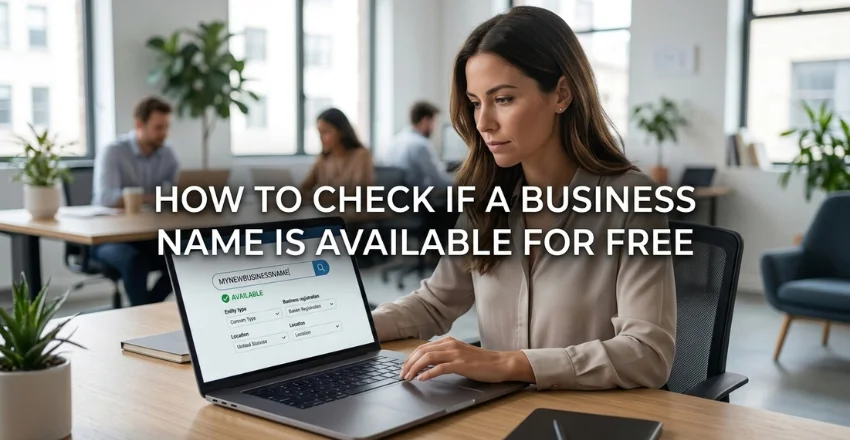
Learning how to check if a business name is available for free can prevent expensive problems before you register. Several U.S. government databases let you perform important searches without paying a fee. Before committing, check state records, trademarks, online use, domains, and local registrations.
No single database can confirm every possible conflict across the United States. State registration, federal trademark rights, and web availability are separate issues. A name that passes one search may still create trouble elsewhere.
Quick answer: Start with your state’s official business entity database, then search federal trademarks through the USPTO. Check Google, domains, social accounts, and local DBA records afterward. These searches are generally free, although registering the company, reserving a name, buying a domain, or filing a trademark can cost money.
Business Name Availability Checks at a Glance
| Check | Where to search | Usually free? | What it tells you |
|---|---|---|---|
| State entity records | Secretary of State or equivalent agency | Yes | Whether similar registered entities exist in your state |
| Federal trademarks | USPTO Trademark Search | Yes | Whether similar federal marks may create conflicts |
| Web search | Google or another search engine | Yes | Whether businesses already use similar wording |
| Domain search | Domain registrar or WHOIS tool | Yes to search | Whether useful web domains appear available |
| Social handles | Major social platforms | Yes | Whether matching brand handles are already used |
| DBA records | State, county, or city offices | Often | Whether local trade names have been filed |
The U.S. Small Business Administration explains that entity names, trademarks, DBAs, and domains protect different things. These registrations remain legally separate. That distinction explains why a single search cannot provide complete clearance.
How to Check If a Business Name Is Available for Free: 6 Steps
The safest approach uses several searches rather than trusting one result. Complete the steps before paying for branding, signs, packaging, or a website. Keep screenshots or notes from each search for your own records.
- Search your state’s official entity database. Find the Secretary of State, corporations division, or equivalent government office. Search the exact wording first, then search distinctive words and close variations.
- Check the USPTO trademark database. Search exact wording plus similar spellings and phrases. Pay attention to marks covering related goods or services.
- Run a broad web search. Search the proposed wording in quotation marks and without quotation marks. Look beyond the first page of results for established companies using similar branding.
- Check domain availability. Search the preferred .com domain and sensible alternatives. A registered domain does not automatically mean the corresponding company name is legally unavailable.
- Search major social platforms. Look for matching and confusingly similar handles on platforms relevant to your customers. Consistent handles can make future branding easier.
- Check DBA or fictitious-name records. Local rules differ, so review your state, county, or city requirements. This step matters when you plan to trade under a name different from your legal entity.
Most states provide public business-record searches online. Registration rules still vary by state and entity type, so use your own state’s official instructions. The SBA notes that LLCs and corporations usually register with a state office.
Start With Your State’s Official Database
Your state entity search should usually be the first formal check. States control the legal names of entities created under their laws. They also apply their own rules for deciding whether two names are distinguishable.
Search more than one variation of your proposed wording. Remove punctuation, change spacing, and search the strongest individual word separately. A narrow exact-match search can miss records that remain relevant to your filing.
Do not treat an empty result as an official approval. The filing office normally decides availability when it reviews your formation documents. Some states also offer separate name-reservation or preliminary availability procedures.
The SBA advises checking the rules for the state where you plan to register. It also explains that most states restrict duplicate entity names. Suffix and entity-designation requirements can differ as well.
Search Federal Trademarks Before You Commit
State clearance does not automatically protect you from trademark problems. A federal trademark can provide nationwide rights related to particular goods or services. That makes a USPTO search an essential second step.
The USPTO provides a public Trademark Search system at no cost. Start with the exact phrase, then search keywords and similar spellings. Look closely at marks used for goods or services related to yours.
Trademark conflicts are not limited to identical wording. The USPTO focuses on whether another mark could create a likelihood of confusion. Similar appearance, sound, meaning, and related commercial use can all matter.
A free database search helps with screening, but it is not legal clearance. Complex searches can require professional review because trademark rights can involve more than federal registrations. Consider legal advice when the brand will carry substantial financial value.
Search for Existing Real-World Use
A company may use a name without holding a federal registration. That is one reason web searches remain important after checking official databases. Search engines can expose companies, products, directories, and local services that government databases may not immediately reveal.
Use quotation marks around the full proposed wording first. Then search without quotes and combine distinctive words with your industry. Add important city or state names when the company will primarily serve a local market.
Check Google Maps and business directories as part of this review. Look for companies serving similar customers rather than counting every matching phrase as a conflict. The goal is to identify realistic sources of confusion before investing in the brand.
Check the Domain and Social Handles
Legal availability and digital availability are different questions. A company can sometimes register an entity even when its ideal .com domain belongs to somebody else. That situation can make marketing harder, even with a successful state filing.
Check the preferred domain before printing or launching anything. Also review reasonable variations that you would be comfortable promoting. Avoid choosing awkward spellings simply because one domain extension happens to be open.
Social handles deserve the same early review. Search platforms where your intended customers spend time, including Instagram, Facebook, LinkedIn, TikTok, and X. Matching handles aren’t legally required, but consistency makes a brand easier to recognize.
Smagazinego’s guide to buyer-focused marketing explains why convenience and communication affect customer decisions. That principle applies to naming because people must easily find and recognize your brand. A confusing web identity can create friction before a customer ever contacts you.
Do Not Forget DBAs and Local Records
A DBA can also be called an assumed, fictitious, or trade name. Registration may happen at the state, county, or city level depending on location. Requirements vary widely across the country.
The SBA notes that a DBA does not create trademark protection on its own. You may still need one when operating under wording different from your registered entity. Check the government offices responsible for your operating location.
Local searches are especially useful for location-based services. A nearby competitor may already use similar branding without appearing prominently in federal databases. Finding that conflict early gives you time to choose clearer wording.
What Does “Available” Actually Mean?

“Available” can describe several different outcomes. Your state might accept the entity name while the matching domain remains registered elsewhere. A federal trademark issue might also exist despite state availability.
| Result | What it means | What it does not mean |
|---|---|---|
| No state match | No obvious state registry conflict appeared | Trademark clearance is confirmed |
| No USPTO result | No obvious federal record appeared in your search | No unregistered rights exist |
| Domain available | The web address may be registerable | The company wording is legally cleared |
| Social handle available | The username can probably be claimed | You have trademark rights |
| DBA search clear | No obvious local filing appeared | State and federal clearance is complete |
Think of name checking as several overlapping screens. Each search answers a different question about registration, branding, or potential confusion. Your strongest choice clears as many relevant screens as possible.
This matters before you spend money on wider business operations. Smagazinego’s coverage of small-business accounting services shows how early administrative choices affect later operations. Branding decisions also become harder to reverse after invoices, accounts, and marketing assets are established.
Common Mistakes to Avoid
One common mistake is checking only a domain registrar. Domains operate under a separate registration system from state companies and federal trademarks. Owning the web address does not grant broad rights to use the wording commercially.
Another mistake is searching only exact matches. Small spelling changes may still matter when consumers could confuse two brands. Search distinctive words, pronunciation variants, and related wording.
Some founders also assume a state filing settles the question nationwide. State entity registration mainly addresses that state’s filing rules. Federal trademark issues require a separate review.
Finally, avoid buying extensive branding before completing your checks. Replacing packaging, websites, advertising, signs, and paperwork can become costly. A few free searches can reveal obvious problems while changes remain easy.
What Should You Do After the Name Looks Clear?
Save your search results and review your state’s filing requirements. You can then register the entity, reserve the name where appropriate, or file a DBA. The next action depends on your structure and location.
Consider registering the domain and relevant social handles soon afterward. Other users can claim these assets independently of government registrations. Secure only the versions that support your real branding plan.
If your company expects to operate nationally, consider whether trademark registration fits your plans. The USPTO offers educational resources for entrepreneurs considering trademark protection. Filing involves requirements beyond performing the free database search.
Businesses planning international growth should also consider future naming conflicts abroad. Smagazinego’s guide to international SEO services explains why country-level markets require separate research. The same planning mindset helps before expanding a brand outside the United States.
Frequently Asked Questions
How to check if a business name is available for free in the United States?
Start with your state’s official entity database and the USPTO Trademark Search system. Then check web results, domains, social handles, and relevant DBA databases. These checks provide a stronger picture than relying on one website.
Is a Secretary of State search free?
Online entity searches are often offered at no fee. Filing, reserving, or registering an entity can still require payment. Always use your state’s official site for current rules and charges.
Does an available LLC name mean I can trademark it?
No, the two systems evaluate different registrations. State entity approval does not guarantee federal trademark registration. Search the USPTO records and review possible confusion with related marks.
Can two businesses use the same name?
Sometimes they can, depending on location, entity rules, industry, and trademark rights. Similar wording becomes more concerning when customers could confuse the businesses. The specific circumstances matter more than a simple nationwide duplicate-name rule.
Should I pay for a company-name search service?
You can perform the basic screening steps yourself for free. Paid services may offer convenience, deeper research, or professional review. They aren’t required to access the main public databases discussed above.
Is checking Google enough?
No, search engines do not replace official state or federal databases. They help you find real-world use and unregistered businesses. Combine web research with government searches for a more reliable review.
Final Checklist Before Registering
Use this short checklist before you commit money to your chosen identity:
- Search your state’s official entity records.
- Search close wording and spelling variations.
- Search the USPTO trademark database.
- Search Google and Maps for existing companies.
- Check the preferred domain and sensible alternatives.
- Review relevant social-media usernames.
- Check local DBA or fictitious-name records.
- Review the final choice before purchasing branding materials.
Treat a clear search result as research, not an absolute legal guarantee. Complete each relevant layer before filing and spending heavily on your identity. That approach gives your new company a cleaner starting point.