

You may already be deep in the process, sorting through treatment plans, hearing different opinions, and trying to figure out who should handle what. One office talks about the crown, another talks about the implant post, and then someone mentions bone grafting, sinus lifts, or impacted teeth. It gets confusing fast. If you are looking for an Oral Surgeon for Basking Ridge NJ, when you are spending real money and trusting people with your health, confusion does not feel small.
The core issue is simple. Dental implants are not just teeth replacements. They involve bone, gums, nerves, healing, bite forces, and long term function. That is why oral surgeons in implant dentistry matter so much. An implant dentist may lead the restorative side, but an oral surgeon often brings the surgical skill needed to place implants safely, manage complex anatomy, and handle complications before they become expensive setbacks.
Oral surgeons strengthen implant outcomes from the start
An implant can look straightforward on the surface. Replace a missing tooth, place an implant, add a crown, move on. Real cases rarely stay that neat. Some patients have bone loss from years of missing teeth. Some have infection under an old tooth. Others grind at night, smoke, take medications that affect healing, or have sinus anatomy that limits placement in the upper jaw.
This is where the partnership matters. An oral surgeon is trained to evaluate the structures beneath the gums, not just the space you see in the mirror. They assess bone volume, nerve position, sinus location, and surgical risk. If a tooth needs extraction and immediate implant placement is being considered, they can judge whether the site is stable enough or whether the bone needs time and grafting first.
That judgment protects you. A rushed implant in weak bone can fail to integrate. An implant placed too close to a nerve can cause numbness or pain. An implant set at the wrong angle can create problems for the final crown, making it harder to clean and harder to bite comfortably. You may only feel that something is off months later, when fixing it costs more than doing it right the first time.
The oral surgeon and implant dentist partnership reduces avoidable risk
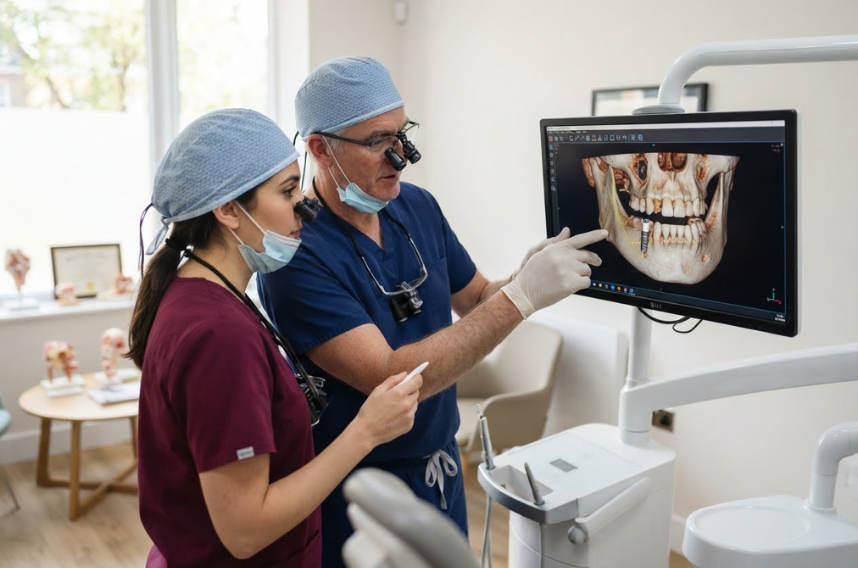
The best implant cases are rarely solo efforts. The implant dentist focuses on how the final tooth should look, fit, and function. The oral surgeon focuses on how the implant gets there safely. That shared planning is what turns a technical procedure into a predictable one.
Think about a patient who lost a molar years ago. The tooth is gone, the bone has shrunk, and the opposing tooth has started to drift. If the case is treated only as a missing tooth, the result may be unstable from the beginning. If the oral surgeon and restoring dentist plan together, they can decide whether grafting is needed, where the implant should sit for proper bite support, and whether timing should change to improve healing.
This kind of teamwork also helps with complex cases such as full arch implants, multiple missing teeth, trauma, failed implants, or severe periodontal damage. In those situations, implant surgery specialists are not an extra layer. They are often the reason the treatment remains possible.
Research from the National Institute of Dental and Craniofacial Research shows how much oral health affects overall quality of life, from eating and speaking to pain and daily comfort. You can review that broader context in the Oral Health in America report. Implant decisions sit inside that bigger picture. They are not cosmetic details. They shape how you live every day.
Implant dentistry depends on materials, healing, and surgical precision
People often focus on the visible tooth and forget that the implant itself is a medical device placed into living bone. Materials, design, and tissue response all matter. The National Institute of Dental and Craniofacial Research provides helpful background on dental materials used in treatment, including the kinds of factors that influence durability and tissue compatibility.
That matters because even a strong material can fail in the wrong setting. If an implant is placed where the bone is too thin, if infection is present, or if the soft tissue seal is poor, the problem is not the crown you see. The problem is the foundation. Oral surgeons are trained to build and protect that foundation, especially when anatomy is limited or healing conditions are less than ideal.
Comparing a coordinated implant team with a limited approach
| Care Approach | What It Often Includes | Common Risks | Likely Benefit |
|---|---|---|---|
| Coordinated care with oral surgeon and implant dentist | 3D evaluation, surgical planning, grafting if needed, restorative planning before placement | Higher upfront planning time and possible added surgical visits | Better implant position, fewer surprises, stronger long term function |
| Implant planned with limited surgical review | Basic placement focus, less coordination on final restoration | Angle issues, thin bone support, esthetic problems, harder cleaning access | May seem faster at first |
| Tooth replacement delayed after extraction | Wait and monitor without preserving bone | Bone loss, drifting teeth, added grafting needs later | Buys time for decision making |
If you speak a language other than English or need materials for a family member, MedlinePlus offers multilingual dental health resources. Understanding the plan clearly is part of good care, not a side issue.
Practical steps help you choose the right implant care
Ask who is handling the surgical phase. Get clear on whether your case includes an oral surgeon, a general dentist placing implants, or a team approach. Ask who will review bone levels, nerve position, sinus anatomy, and grafting needs. If the answers feel vague, pay attention to that.
Request planning details before treatment starts. You should know the sequence. Will the tooth be extracted first. Is bone grafting planned. Is the implant immediate or delayed. Who designs the final crown. Good oral surgery and dental implant care is planned backward from the final result, not improvised in the chair.
Think beyond the day of surgery. Ask how the implant will be maintained, what healing will involve, and what could change the timeline. If you grind your teeth, smoke, have diabetes, or have had gum disease, bring it up early. These details affect success more than people realize.
Strong implant results usually come from strong collaboration
You do not need to become an expert in every part of implant treatment. You do need a team that respects how many parts are involved. When oral surgeons and restorative dentists work together, the process is safer, the planning is sharper, and the result is more likely to feel like your own tooth instead of a compromise.
If you are weighing your options for an oral surgeon and implant dentist, choose a team that explains the plan clearly, addresses surgical risk honestly, and builds the case around long term function, not speed alone.