
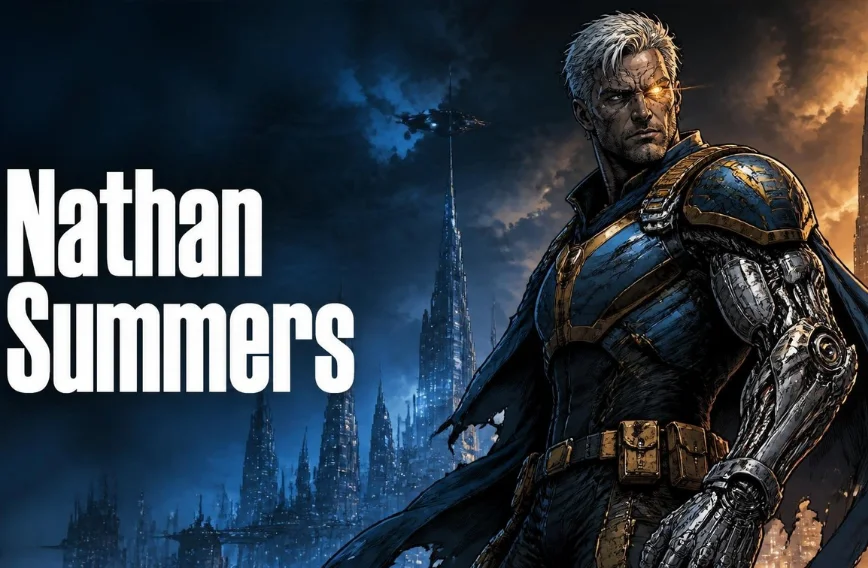
Nathan Summers is better known to Marvel fans as Cable, the time-traveling mutant soldier linked closely with the X-Men. He is the son of Scott Summers (Cyclops) and Madelyne Pryor. His complicated history connects cloning, time travel, Apocalypse, X-Force, and several generations of the Summers family.
Direct answer: Nathan is Cable, a powerful mutant born to Cyclops and Madelyne Pryor. Apocalypse infected him with a techno-organic virus while he was an infant. Nathan was sent into the distant future for treatment, grew into a formidable soldier, and eventually returned to the present as Cable.
Cable Quick Facts
| Detail | Information |
|---|---|
| Full name | Nathan Christopher Charles Summers |
| Better known as | Cable |
| Father | Scott Summers, or Cyclops |
| Mother | Madelyne Pryor |
| Publisher | Marvel Comics |
| Species | Human mutant |
| Main powers | Telekinesis, telepathy, force fields, teleportation |
| Major teams | X-Force, X-Men |
| Major enemy | Apocalypse |
| Important family connection | Adoptive father of Hope Summers |
| Comic debut as Nathan | Uncanny X-Men #201 |
| Debut as Cable | The New Mutants #87 |
Marvel’s official profile lists Cable among its major mutant heroes and highlights his ties to both X-Force and the X-Men. His unusual biography makes him much harder to summarize than most superheroes. Understanding his childhood first makes the rest of his timeline much easier to follow.
Who Is Nathan Summers in Marvel Comics?
Nathan is the biological son of Cyclops and Madelyne Pryor, rather than Jean Grey. Madelyne was created as a clone of Jean by Mister Sinister. Sinister wanted a child with combined powerful mutant genetics for purposes tied to his conflict with Apocalypse.
Nathan first appeared as a baby in Uncanny X-Men #201, published in 1986. Cable later appeared as an adult warrior in The New Mutants #87 in 1990. Marvel did not initially present Cable as the grown version of the earlier infant character.
That distinction helps explain some of the confusion around his early publication history. Writers eventually established that the mysterious soldier was the adult version of Cyclops’ son. The revelation tied two seemingly separate Marvel characters into one sprawling timeline.
Nathan Summers’ Origin: How He Became Cable
Nathan’s life changed dramatically after Apocalypse targeted him as an infant. Apocalypse infected the child with a dangerous techno-organic virus. The infection gradually converted organic tissue into technological material and threatened Nathan’s survival.
Technology could slow the infection, but Nathan needed help that didn’t exist in his era. A member of the Askani offered the possibility of saving him in a distant future. Cyclops eventually agreed to send his son forward through time.
Nathan grew up in a future shaped by conflict and Apocalypse’s influence. He learned to use his mutant abilities while constantly controlling the infection inside his body. Those circumstances helped transform Cyclops’ child into the hardened soldier readers know as Cable.
Why Does Cable Have a Metal Arm and Glowing Eye?
Cable’s metallic appearance is closely connected with the techno-organic virus affecting his body. His condition produced the cybernetic look associated with his arm and eye. It also forced him to devote considerable mutant power to keeping the infection under control.
That limitation is important when comparing his visible abilities with his potential power. He possesses formidable psychic abilities, including telepathy and telekinesis. A large portion of that strength has traditionally been required to contain his infection.
The result gives Cable an unusual mixture of mutant powers and futuristic technology. His weapons and cybernetic elements make him resemble a heavily armed soldier. Beneath that equipment, however, his natural mutant abilities remain central to the character.
What Powers Does Nathan Summers Have?
Marvel lists Cable’s core abilities as telekinesis, telepathy, force-field generation, and teleportation. His telekinesis lets him manipulate physical objects through mental force. His telepathy gives him considerable psychic abilities involving other minds.
His fighting effectiveness also comes from years of combat experience and future technology. Cable frequently uses advanced firearms and equipment rather than relying entirely on mutant powers. That combination distinguishes him from more conventional psychic X-Men characters.
His abilities can vary across stories because of illness, technology, timeline changes, and other narrative circumstances. Some versions emphasize his psychic potential, while others focus heavily on military skills. That flexibility has helped writers place him in superhero, science-fiction, and time-travel stories.
The Summers Family Connection Explained
Cable belongs to one of Marvel’s most complicated superhero families. Scott Summers is his biological father, while Madelyne Pryor is his biological mother. Jean Grey has also played a major role in his family history despite not being his biological mother.
Rachel Summers is another important part of the extended Summers mythology. Different realities and timelines make exact relationships more complicated than an ordinary family tree. Marvel’s use of alternate futures adds further variations, including characters like Nate Grey.
Stryfe creates another major complication because he originated as a clone connected directly with Cable’s future. The characters became bitter enemies and central figures in several major stories. Their shared genetics fueled years of mystery over which character was the original.
Cable and X-Force
Cable became closely associated with the New Mutants after returning to the present. He eventually reorganized the young mutant group into X-Force, giving the team a more militant approach. Marvel describes him as the original leader of the mutant commando team.
X-Force traditionally tackles threats through methods that differ from the main X-Men team. Cable’s future experience and military thinking fit that mission naturally. Characters including Domino, Cannonball, Boom-Boom, Warpath, and Shatterstar became associated with his early roster.
His leadership of X-Force helped establish the identity most comic readers recognize today. He was no longer simply Cyclops’ time-displaced son. He became a commander with his own allies, enemies, missions, and philosophy.
For more pop-culture profiles and entertainment explainers, readers can browse Smagazinego’s Entertainment section. The site also publishes character-focused explainers such as its End of Evangelion analysis.
Cable and Hope Summers
Hope Summers represents another defining relationship in Cable’s history. After the mutant population faced a major crisis, Cable protected an infant believed to be of enormous importance to mutantkind. He took her through time while escaping enemies determined to capture or kill her.
Cable raised Hope as his daughter while teaching her how to survive. Their relationship revealed a more protective side of a character often defined by weapons and warfare. His role as her father became one of his most emotionally important storylines.
Hope eventually became deeply connected with the future of mutantkind. Cable’s commitment to protecting her therefore affected much more than his personal story. Their bond tied his time-travel mythology to major developments across the wider X-Men universe.
Cable and Nathan in X-Men ’97
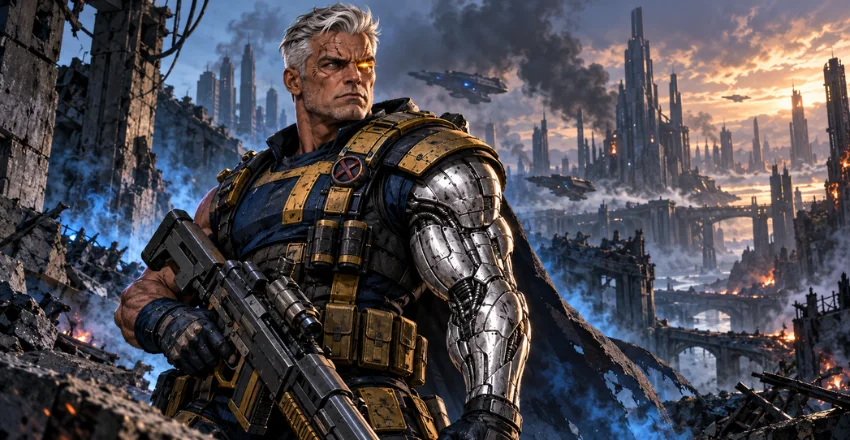
X-Men ’97 brought Cable’s unusual family story to a much wider television audience. The series identifies baby Nathan as Cyclops and Madelyne Pryor’s child. When the techno-organic infection threatens him, the child must be taken into the future.
That storyline gives viewers a clearer bridge between infant Nathan and the older Cable seen in X-Men animation. The original animated series had suggested connections between Cable and the Summers family without completely explaining them. The newer story makes the relationship far more explicit.
The adaptation simplifies material that unfolded across years of comics. That makes the animated version useful for viewers unfamiliar with Marvel’s many alternate timelines. Readers should still expect differences between television continuity and Earth-616 comic continuity.
Why Cable’s Timeline Gets So Confusing
Cable’s story involves time travel, plus clones, alternate realities, younger versions, and changed futures. As a result, a character can encounter relatives at ages that seem impossible under normal chronology. Marvel has repeatedly used that flexibility as part of Cable’s storytelling identity.
The easiest approach is to remember four events in sequence. Nathan is born to Cyclops and Madelyne, becomes infected, travels into the future, and returns as Cable. Most of the complicated stories branch from those four points.
Marvel has also published stories featuring a younger Cable in contemporary adventures. Those stories should not be treated as evidence that the classic adult soldier is a separate person. Time displacement allows different stages of his life to become active parts of Marvel continuity.
Readers who enjoy detailed entertainment biographies can also explore Smagazinego’s Otis Williams profile and its broader entertainment coverage.
Why Cable Matters to the X-Men
Cable connects several major eras of X-Men storytelling through one character. His birth ties him directly to Cyclops, Madelyne Pryor, Jean Grey, and Mister Sinister. His future connects him with Apocalypse, while his present-day missions link him with X-Force and numerous mutant heroes.
He also represents a different philosophy from Professor Xavier’s traditional approach. Cable often prepares for catastrophic threats before they happen because he has witnessed possible futures. That perspective can make his methods aggressive, but it also explains his urgency.
His importance therefore extends beyond complicated family trivia. He connects the X-Men’s family drama with futuristic science fiction and military storytelling. Few Marvel characters move between those genres as naturally.
Frequently Asked Questions About Nathan Summers
Is Nathan Summers the same person as Cable?
Yes, Nathan is Cable in Marvel Comics. Nathan is born in the present but gets sent into the future after contracting a techno-organic virus. He later returns as the adult time-traveling warrior known as Cable.
Who are Cable’s parents?
Cable’s biological parents are Scott Summers (better known as Cyclops) and Madelyne Pryor. Madelyne is a clone of Jean Grey created by Mister Sinister. Jean still plays an important role in Nathan’s broader family history.
Is Jean Grey Cable’s mother?
Jean Grey is not Cable’s biological mother in the main Marvel comic continuity. His biological mother is Madelyne Pryor, who was created as Jean’s clone. Jean nevertheless develops an important parental connection with him through later events.
Why was Cable sent to the future?
He was sent forward because Apocalypse infected him with a dangerous techno-organic virus. The Askani offered a chance to save the infant in their future era. That journey eventually led to his upbringing as a warrior.
Who is stronger, Cable or Cyclops?
Their powers work differently, so a simple strength comparison can mislead readers. Cyclops specializes in powerful optic blasts, while Cable has major psychic abilities and advanced combat technology. Cable’s techno-organic condition has also affected how much psychic power he can use.
Is Cable part of the X-Men or X-Force?
He has connections with both teams, but his history with X-Force is especially important. Cable reorganized the New Mutants into the more militant X-Force. Marvel also lists him among characters associated with the wider X-Men universe.
The Takeaway
Cable becomes much easier to understand once his story is reduced to its core sequence. Cyclops and Madelyne Pryor have a son, Apocalypse infects him, and the child travels into the future. He grows into a soldier and later returns to his original era.
Everything surrounding that foundation adds another layer rather than replacing it. X-Force, Stryfe, Hope Summers, and alternate timelines expand the same central biography. That combination has made Cable one of Marvel’s most distinctive mutant characters.
Readers looking for more character profiles, film discussions, and pop-culture explainers can continue through Smagazinego’s Entertainment coverage. It provides the closest topical home for this article on the site.