

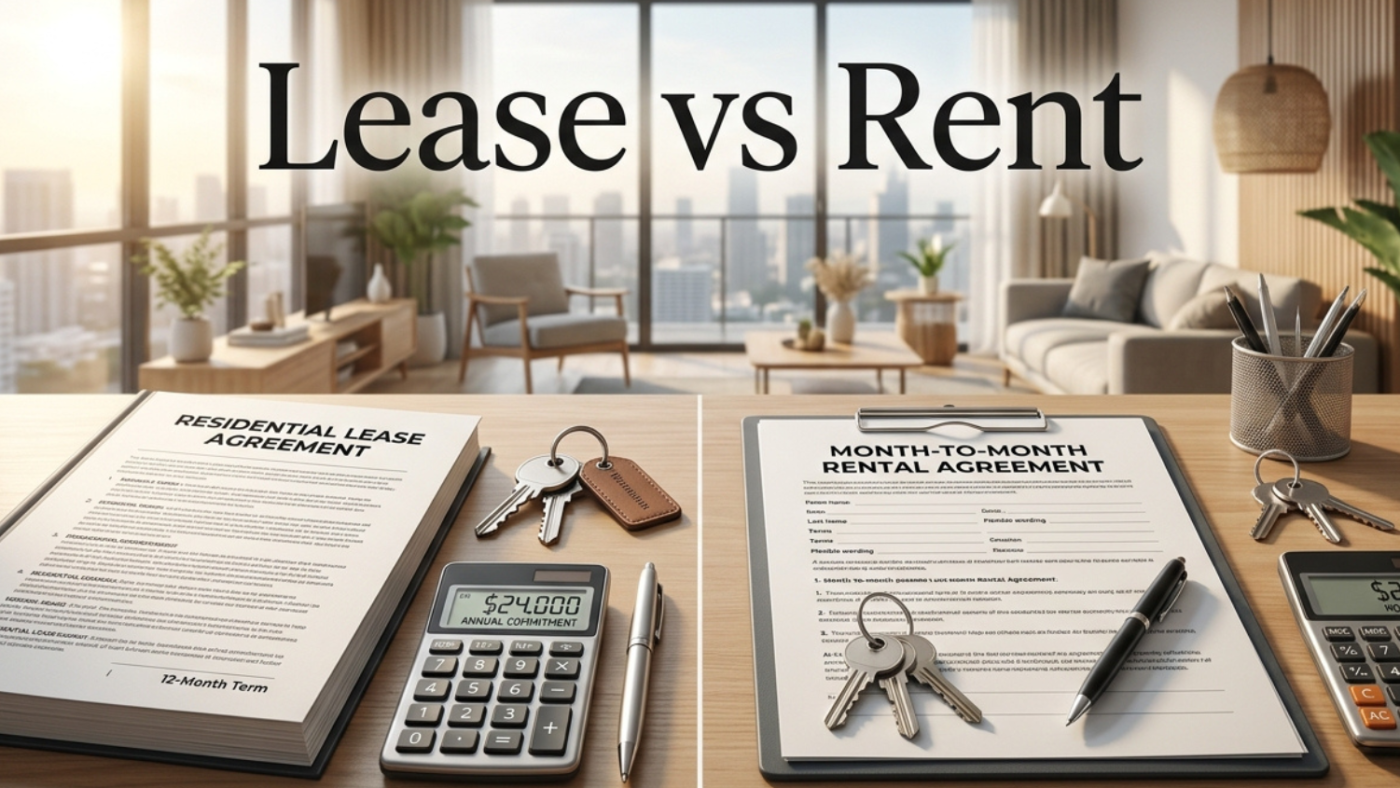
Lease vs rent usually comes down to commitment length and flexibility in U.S. housing. A fixed-term lease usually locks both parties into stated terms until a set end date. A month-to-month rental agreement renews more often and can change or end with proper notice.
| Key point | Fixed-term agreement | Month-to-month rental |
|---|---|---|
| Typical duration | Often six or twelve months | Usually renews monthly |
| Price stability | Rent usually stays fixed during the term | Rent may change with required notice |
| Flexibility to move | Lower | Higher |
| Ending the arrangement | Usually tied to the end date or contract terms | Usually possible with required notice |
| Renewal | May require renewal, conversion, or move-out | Usually renews each rental period |
| Best fit | Tenants seeking stability | Tenants needing flexibility |
For most U.S. tenants, a fixed-term agreement offers more price stability, while month-to-month renting offers more mobility. The better fit depends on how long you expect to stay. State and local law can change notice rules, renewal rights, and allowable rent increases, so always check your location.
Key Takeaways
- A fixed-term agreement gives stronger timing and payment predictability.
- Month-to-month renting gives you more freedom to relocate sooner.
- Leaving a fixed term early can trigger costs or other obligations.
- State and local rules can change notice periods and rent increase requirements.
- Read renewal, termination, deposit, utility, and fee clauses before signing.
Lease vs Rent: What the Terms Mean
In everyday conversation, people often use lease and rental agreement as synonyms. Legally, the distinction often concerns a fixed term versus a periodic tenancy. Cornell’s Legal Information Institute describes rental agreements as commonly covering short periods, often monthly.
Rent is the payment you make to use a property. A written agreement sets the conditions for that occupancy. That document may create a fixed term, a month-to-month tenancy, or another lawful arrangement.
7 Key Differences Between Fixed-Term and Month-to-Month Housing
The main differences affect commitment, budgeting, and how quickly either side can change the arrangement. These details matter when your job, school, family, or finances may change. This comparison focuses on common U.S. rental practices.
1. Term Length
A fixed-term contract has a stated start and end date. Six-month and twelve-month terms are common examples. A monthly rental continues through recurring periods until someone gives valid notice.
2. Rent Stability
A fixed-term contract usually keeps the stated monthly payment unchanged during its term. Changes may occur if the agreement allows them or applicable law permits them. Month-to-month pricing can usually change after proper notice, subject to local limits.
3. Flexibility to Move
Month-to-month housing usually gives tenants more freedom to relocate. You must still follow the required notice period. A fixed commitment can be harder to exit before its stated end date.
4. Early Termination Risk
Leaving a fixed term early can create financial consequences. The agreement may include an early termination clause, reletting charge, or other lawful obligation. State law can also affect what a landlord may collect after you leave.
5. Renewal Rules
A fixed term may end, renew, or convert to month-to-month occupancy. The outcome depends on the contract and local law. Never assume that staying after the end date creates the same arrangement everywhere.
6. Changes to Rules
A fixed term usually limits mid-contract changes unless the agreement already allows them. Monthly arrangements allow more room for lawful changes with the required notice. Those changes can include rent, services, or other tenancy terms.
7. Planning Certainty
A fixed term can simplify budgeting when you expect to stay put. Monthly renting suits people facing an uncertain move date. Your likely timeline should guide the choice more than the label.
Pros and Cons of Each Option

A fixed-term lease favors stability, while monthly renting favors mobility. Neither structure suits every renter. Your priorities, local market, and expected moving date should drive the decision.
Fixed-term agreement pros
- More predictable housing timeline.
- Greater protection from sudden contractual changes during the term.
- Easier long-range budgeting when the monthly payment stays constant.
Fixed-term agreement cons
- Less freedom to move on short notice.
- Early departure can create costs or continuing obligations.
- Renewal terms may bring a new price or different conditions.
Month-to-month rental pros
- Easier to leave after the required notice.
- Useful for temporary jobs, uncertain plans, or transition periods.
- No need to commit to a long fixed period.
Month-to-month rental cons
- Less certainty about future pricing.
- The landlord may also have more flexibility to end the tenancy.
- Frequent changes can make long-term budgeting harder.
Which Option Should You Choose?
Choose a fixed-term agreement if you expect to stay and value predictable costs. Choose month-to-month renting if flexibility matters more than long-term certainty. That is the practical lease vs. rent decision for most U.S. tenants.
A simple test can help before you sign. Ask whether you expect a job change, school move, household change, or relocation within twelve months. If the answer is yes, flexibility may be worth paying more for.
| Your situation | Better starting point | Why |
|---|---|---|
| You expect to stay at least a year | Fixed-term agreement | Predictable term and payment |
| You may relocate soon | Month-to-month rental | Easier exit with proper notice |
| You dislike uncertain rent changes | Fixed-term agreement | Stronger price stability during the term |
| You are testing a new city | Month-to-month rental | Lower commitment |
| You need housing between moves | Month-to-month rental | Better for temporary occupancy |
What to Check Before Signing
Read the entire agreement before paying a deposit or moving in. Focus on the clauses that can create surprise costs later. Keep a signed copy where you can access it easily.
- Confirm the exact start date, end date, and renewal process.
- Check the monthly payment, due date, late fees, utilities, and recurring charges.
- Review the security deposit amount and the rules for deductions.
- Find the required notice period for moving out or declining renewal.
- Read any early termination, subletting, assignment, or reletting clauses.
- Check pet, guest, parking, maintenance, and renter’s insurance requirements.
- Review any clause allowing future price or rule changes.
If you are still choosing a neighborhood, start with Smagazinego’s home-search guidance. Its planning tips can help you compare location, budget, and daily needs before committing. You can also review the site’s real-estate buying guide if renting is only one option you are considering.
U.S. Tenant Rules Vary by State and City
No single U.S. rule covers every rental relationship. State statutes and local ordinances can change notice periods, deposit handling, rent increases, and termination rules. Cornell notes that landlord-tenant law comes from state law, local ordinances, common law, and some federal law.
If a dispute develops, start by reading your signed agreement and checking official local guidance. USAGov directs renters to state tenant-rights resources, including state agencies, housing offices, and legal aid resources for tenant-rights questions. Smagazinego’s Law section can also help you explore broader legal topics in plain language.
Money questions can also shape your housing choice. A stable monthly payment may simplify budgeting, while flexibility can reduce moving risk. Smagazinego’s Finance section offers related financial planning content for household decisions.
Frequently Asked Questions
Is Lease vs Rent the Same Thing?
Not exactly, although people often use the words interchangeably. Rent usually means the payment, while the agreement defines your tenancy. A fixed-term contract and a month-to-month rental can create different rights and obligations.
Can a Landlord Raise Rent During a Fixed-Term Agreement?
Usually, the stated price remains in place for the term. Exceptions can depend on contract language and local law. Check the signed document and your state or city rules before assuming an increase is valid.
What Happens When a Fixed-Term Lease Ends?
Several outcomes are possible after the end date. You may move out, sign a new contract, or continue under a periodic arrangement. The original document and local law determine what happens next.
Is Month-to-Month Renting More Expensive?
It can be, but pricing depends on the property and local market. Some landlords charge more for flexibility or shorter commitments. Compare the total monthly cost instead of assuming one structure always costs less.
Can You Break a Lease Early?
You can leave, but leaving does not automatically erase your contractual obligations. Review termination, subletting, assignment, and reletting terms before acting. Local law may also limit or define what amounts remain due.
The Bottom Line
Choose stability when your plans are steady, and flexibility when they may change. Then compare the exact contract terms instead of relying on labels alone. Review carefully before signing to avoid expensive misunderstandings later.
Before committing, compare the payment, notice rules, renewal language, and early-exit terms side by side. Check state and local tenant guidance if anything is unclear. That small review can protect your budget and make your next move easier.