


If you see the word invitee, it usually means a person who has been invited somewhere. The term can describe someone invited to a wedding, meeting, party, conference, or other event. In U.S. law, the same word can also carry a more specific meaning involving people who enter another person’s property.
| Quick fact | Answer |
|---|---|
| Word | Invitee |
| Part of speech | Noun |
| Basic meaning | A person who is invited |
| Pronunciation | Roughly “in-vy-TEE” |
| Plural | Invitees |
| Common synonym | Guest |
| Opposite role | Inviter or host |
| Common settings | Events, meetings, invitations, business, and law |
| Legal meaning | Someone entering property through an express or implied invitation |
Direct answer: An invitee is someone who receives an invitation to attend an event, enter a place, or participate in an activity. In everyday English, the word is similar to “guest.” In U.S. premises liability law, it may describe someone entering property with the owner’s express or implied invitation.
What Does Invitee Mean?
The simplest definition is a person who is invited. The invitation may involve a social gathering, business event, ceremony, meeting, or another organized activity. The word focuses on the person receiving the invitation rather than the person sending it. For example, a couple may prepare a list of people invited to their wedding. Each person on that list can be described using this term. The same wording can apply to people invited to conferences, private dinners, award ceremonies, or professional meetings.
The word often sounds more formal than “guest” in American English. You may encounter it in event planning systems, official communications, attendance lists, and legal writing. Casual conversations usually favor simpler words such as “guest.”
How Do You Pronounce It?
In American English, the word is pronounced roughly as “in-vy-TEE.” The strongest stress falls on the final syllable. That ending follows the pattern found in several English nouns ending with “-ee.” The pronunciation can seem confusing when someone first sees the word in writing. Reading it as “invite” with an extra “ee” may lead to misplaced stress. Remembering the stronger final “TEE” sound makes the pronunciation easier. You may also hear small pronunciation differences between speakers or regions. Those differences do not change the meaning. Standard dictionaries place the main stress on the final syllable.
Invitee, Guest, Attendee, and Inviter: What’s the Difference?
These words overlap, but they do not always describe the same relationship. Choosing the correct term depends on whether you mean an invitation, attendance, or hosting. The following comparison shows the main differences.
| Term | Basic meaning | Must be invited? | Must attend? |
|---|---|---|---|
| Invitee | Person who receives an invitation | Yes | No |
| Guest | Person welcomed at an event or place | Usually | Usually |
| Attendee | Person who attends an event | No | Yes |
| Inviter | Person who sends an invitation | No | No |
| Host | Person or group receiving guests | No | Usually |
An invitee does not automatically become an attendee. Someone might receive a wedding invitation and decline it. That person was invited, but they never attended the event.
“Guest” often works as a natural substitute in everyday conversation. Still, the two words can emphasize different things. “Invitee” emphasizes receiving an invitation, while “guest” emphasizes being welcomed or hosted. This distinction resembles other small English usage differences. Smagazinego’s guide to blonde versus blond shows how similar words can carry different usage patterns. Checking context usually reveals which term fits best.
What Is the Plural of Invitee?
The plural form is invitees. You form it by adding “s” to the singular noun. No spelling change is needed before adding the plural ending. For example, you might write, “All invitees should respond by Friday.” Another example is, “The conference organizers emailed the invitees before registration opened.” Both sentences refer to multiple people who received invitations. The possessive forms follow standard English patterns. “Invitee’s” describes something belonging to one invited person. “Invitees’” describes something belonging to multiple invited people.
How Is the Word Used in Everyday English?
The term appears frequently when people discuss guest lists and event planning. A wedding organizer might track responses from invited guests. A company might also maintain a list for a private conference or networking event. Digital invitation systems can use the term for people receiving invitations by email or text. Organizers may track whether each person has accepted, declined, or not responded. This makes the word useful when attendance remains uncertain. The concept also appears naturally in online communication. Digital language often develops specific terms for roles, reactions, and social interactions. Smagazinego’s guide explaining what UwU means online offers another example of how context shapes modern language.
Invitee Meaning in U.S. Law
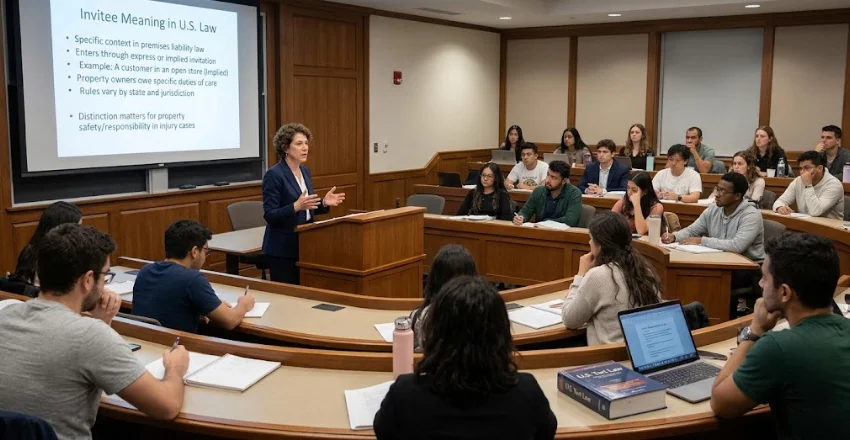
The legal meaning can be more specific than the everyday definition. In premises liability law, the term may describe someone entering property through an express or implied invitation. A customer entering an open store is a common example of an implied invitation. Property owners may owe certain duties of care to people who enter their premises. The precise legal rules vary by state and by the circumstances involved. Courts may also distinguish among visitors differently depending on the jurisdiction.
This legal use should not be confused with simply receiving a party invitation. Legal classifications can affect questions about property safety and responsibility after an injury. Anyone dealing with a specific premises liability dispute should consult applicable state law or qualified legal counsel. Legal vocabulary often gives familiar expressions narrower meanings. Smagazinego’s guide to ex post facto laws in the United States explains another term whose legal meaning requires context. Reading the surrounding material matters when a familiar phrase appears in a legal document.
Business Invitees and Social Guests
A business visitor can receive an implied invitation without getting a written invitation. Customers enter stores because the business opens its premises for shopping. Restaurant customers and certain other commercial visitors may fit similar legal concepts. A social guest enters property for a different reason. State law may classify social guests differently from customers or other business visitors. That difference can affect which legal duties apply after an accident.
Because premises liability rules vary across the United States, broad definitions have limits. A dictionary can explain the term, but it cannot determine someone’s legal status in every case. The facts and relevant state law must be considered together.
Common Examples in Sentences
Seeing the term in context makes its meaning easier to remember. Most examples emphasize someone who received permission or a request to attend something. Formal writing uses the term more often than casual conversation.
- Each invitee received a personalized wedding invitation.
- The organizer asked every invitee to respond before Friday.
- Conference invitees received registration instructions by email.
- One invitee could not attend because of a scheduling conflict.
- The final list included employees, clients, and other invitees.
- In a legal context, a store customer may be treated as a business invitee.
These examples show why the term is useful. It identifies the recipient of an invitation without confirming that the person attended. That distinction becomes especially useful when managing RSVPs or discussing planned attendance.
Common Mistakes to Avoid
One common mistake is treating “invitee” and “attendee” as identical. An invitee can decline, while an attendee has already attended or plans to attend. The distinction becomes useful when discussing event numbers. Another mistake involves confusing the recipient with the sender. The inviter sends or extends the invitation. The invitee receives it, so the two terms describe opposite sides of the same action. Writers should also avoid forcing the formal term into casual sentences. “We have ten guests coming for dinner” usually sounds more natural than formal event-planning language. Choose the word that matches the setting and audience.
Why Does the Word End in “-ee”?
The “-ee” ending often identifies someone who receives an action. English contains similar pairs such as employer and employee. The ending therefore helps show the relationship between inviting and being invited. The word developed from “invite” plus the “-ee” suffix. That structure makes its meaning easier to remember once you recognize the pattern. The inviter performs the action, while the invitee receives it. Still, English suffixes do not follow one perfect rule in every word. Context remains important when learning unfamiliar vocabulary. Treat the suffix as a useful clue rather than a universal formula.
The Simple Takeaway
The word is straightforward once you separate invitation from attendance. It describes someone who has been invited, while “attendee” confirms attendance and “inviter” identifies the sender. “Guest” remains the closest everyday alternative in most social settings. The legal meaning deserves extra attention because U.S. premises liability rules can give the term greater significance. Always consider the context before interpreting it in a contract, court document, or legal discussion. For ordinary events and invitations, think simply of the person receiving the invitation.
Frequently Asked Questions
What does invitee mean in simple words?
An invitee is a person who has been invited somewhere or asked to participate in something. That could include a wedding, party, meeting, conference, or private event. In everyday conversation, “guest” is often a simpler alternative.
Is an invitee the same as a guest?
The meanings are similar, but the emphasis differs. The first term highlights that someone received an invitation. “Guest” usually emphasizes that someone is being welcomed or hosted.
Is an invitee the same as an attendee?
No, because receiving an invitation does not prove that someone attended. An attendee is someone who goes to an event. A person can receive an invitation and decline it.
What is the opposite of an invitee?
“Inviter” can describe the person who sends an invitation. “Host” may also fit when discussing parties, gatherings, or events. The best choice depends on the relationship being described.
What does the word mean legally?
In U.S. premises liability law, it can describe someone entering property through an express or implied invitation. Customers entering businesses are common examples used to explain the concept. Exact duties and classifications can vary by state.
How do you spell the plural form?
The plural is “invitees,” with an “s” added to the singular form. No other spelling change is required. For example, you could write, “The invitees received confirmation emails.”